Showing posts with label Marconi. Show all posts

Saturday, 22 February 2014

Morskie Oko

Hi there, here it's Mike. Remember me?


Rick is having some troubles with the internet on his way to a new country he will visit now. Therefore he has asked me to post a new story today so that you do not have to wait too long. I am now in Warsaw, watering Rick's plants, so I will show you what I have been doing  recently here.

* * *

Since the human family I came with has small kids, I have asked Rick to recommend me a nice park where we could spend an hour or two even on a colder day. Luckily, this winter is pretty warm in Poland. Though probably the kids would prefer to see a bit of snow. Anyway, we headed today to the Morskie Oko Park. It is located in the center of the city, next to a busy street (and a police station).


 The park is not very big and in this time of the year it is not very crowded.


It owes its name to the lake located in the central part of the park. Apparently its shape resembles the Morskie Oko lake in Tatra mountains.


In the middle of the lake there is a nice fountain.


I have left the kids on a playground.


Let's check if there is any building of interest here.


Here, up the hill there is a yellowish building. I will go closer.


This is the palace of the Szuster family. It was originally built in the eighteenth century, then rebuilt in the nineteenth, based on a desing by Henryk Marconi. It was destroyed during Worldk War II and rebuilt in 1960s, just like many other buildings of this type in Warsaw (remember Królikarnia?).


Unfortunately, it is not in its best shape today.


What is pretty amazing is that just next to the palace there is a public school ...


... and appartment blocks from the 1960s and 1970s, built in the socialist style.


When going down the hill I have noticed a small structure. This is the tomb of the Szuster family. It must have been very practical when the whole areas belonged to the family, probably a bit less nice nowadays. Especially for the neighbours.


Let's walk down the alley back to the playground where I have left the human family.


I only propose we stay a moment next to the fountain and enjoy the silence while we still can.


Saturday, 13 April 2013

Jewish district in Warsaw

If you would walk around Warsaw and ask people whether Warsaw has a Jewish district you are almost sure to hear that no. Only if you are lucky to meet an older person who was born in the city you may be advised to go to the surroundings of the Grzybowski Square. Before World War II it was a vibrant place that was the home for many Jews. During the war the district was almost entirely detroyed and most of the inhabitants perished in nazi concentration camps. Nowadays, you will only be able to see some sad remainings.

The square itself is not really square but triangular. In the middle there are a few benches and a little lake with a fountain that works in summer time.


The building in the back is the Jewish Theater. I've heard it is the only theater in the world that gives regular spectacles in the yiddish language.


Here is the main entry to the theater. It is named after two famous Jewish actresses, Estera and Ida Kamiński. They both worked in this theater until March 1968 when the Polish government employed anti-Semitic measures. As a result, many Polish citizens of Jewish origin had to leave the country permanently.


Behind the theater you can see some further proofs that the Jewish culture is still present in Warsaw. First of all, you can see the Nożyk Synagogue, an orthodox Synagogue named after its founders.


It has been refurbished recently.


The style is a bit similar to what we have seen in Josefov in Prague. It was designed by Leonardo Marconi.


Next to the synagogue is the seat of the Union of Jewish Religious Communities in Poland.


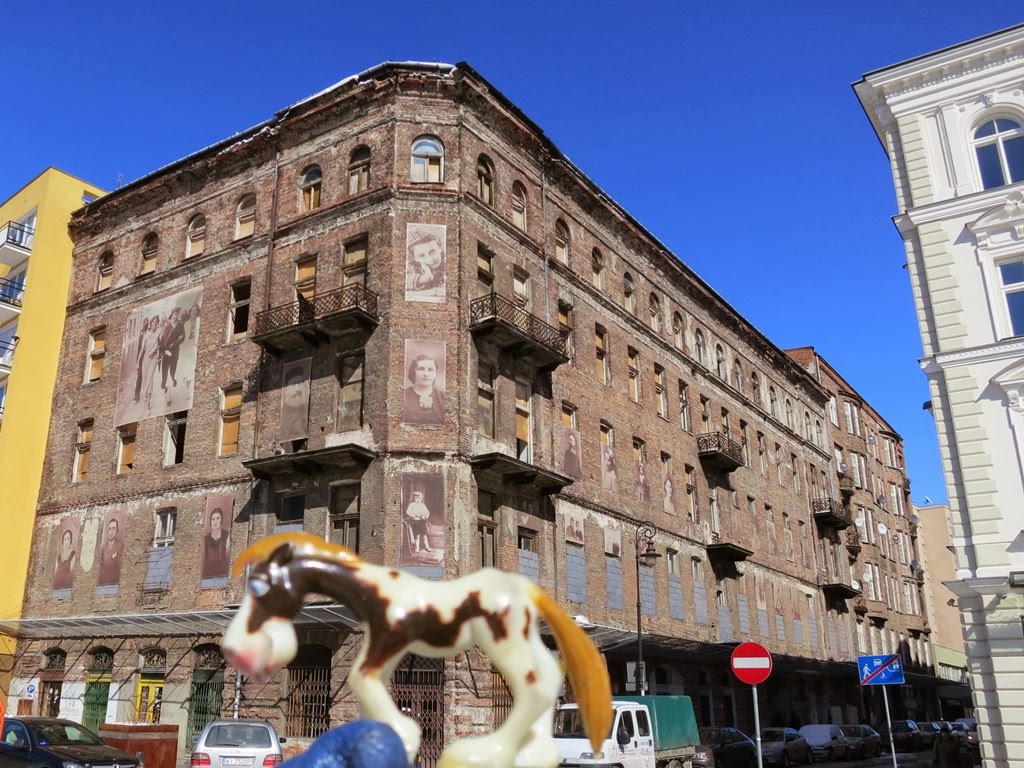
When you turn your back to the Jewish theater and look at the other side of the Grzybowski square, you will for sure notice a building made of brick with huge pictures. These are pictures of various Polish Jews. They are exhibited there by the Foundation Shalom.


The third side of the square (as you remember it is a triangle) is occupied by the Church of All Saints. It was designed by an architect you know well, Enrico (Henryk) Marconi, the father of Leonardo. It was for a long time the church of Christians who converted from Judaism.


Next to the stairs you can see a monument of Pope John Paul II. There are hundreds of such monuments in Poland, as you know the Pope was Polish. This particular one commemorates a mass he has held in this church. As a point of interest, one of the participants was Mother Theresa from Calcutta.


And one final remark. If you think that this Jewish district is somewhere far in a remote suburb you are wrong. It is in the very center of Warsaw. When you just take a step on the left side of the church you will see the Palace of Culture and Science, standing proudly in the sun.


Saturday, 19 January 2013

Saski Garden and Saski Palace

The Saski (or Saxon) Garden is the oldest public garden in Warsaw, it was opened in early 18th century. It ownes its name to the Saxon dinasty that ruled Poland at the time it was created. The main element of the part is the fountain. It is closed in winter unfortunately.


The garden is not very big but it has a nice symetry.


You probably wonder what is this engraved place on which I stand. This is a solar clock or a sundial. The date engraved on it is 1863.


As you see, the lanes are decorated with nice statues. They represent various topics, like times of the year, types of arts or virtues. They total up to 21.


The garden includes also a small lake. The building in the back is a part of the Warsaw water system. It was designed by Enrico (Henryk) Marconi, the same who has designed the health spa in Busko-Zdrój that I have shown some time ago.


You probably noticed that the lake is completely frozen. Just a small place for the ducks.


Originally, the most important building in the Garden was the Saski Palace. Unfortunately, it was almost entirely destroyed during World War I. Only a small balcony part remained. It was then turned into a monument devoted to the Unknown Soldiers who have given their lives for Poland. Since its creation it was a very important place for all Polish people. This was one of the reasons why nazis destroyed it in 1944. It was reconstructed after World War II in its current shape.


The Tomb is guarded by soldiers, day and night. An eternal fire is burning.


You can see the list of major battles in which Polish soldiers perished on the tables on the walls of the Tomb. This one shows the first ones, starting back in 972 (and no, I did not miss "1" at the beggining, the Polish state dates back to the 10th centruy).


Before the Tomb you will see the square devoted to marchal Piłsudski. It is the major place of gatherings and public events of historical value. One of them is comemmorated by this cross.


It was built in the memory of a mass that the pope John Paul II had on the square in June 1979. He then said "May the Holy Spirit change this land". Many Poles believe it to be a prohecy that fulfilled itself in 1989 when Poland regained its full independence.


The surroundings of the Saski Garden are also very interesting. But I will show you them in a separate note.

Saturday, 22 October 2011

Busko-Zdrój (part.1)

Busko-Zdrój is a town in the South of Poland. It is most known for its health waters and related sanatoriums (health spas). What I liked best were the parks. Currently there are two "health spa" parks nowadays, located next to each other.

The so-called "New Park" is composed mainly of pitches and includes a nice lake.


There are lanes to walk through and benches to sit at.


On a sunny day you can also sit by this nice fountain - a very refreshing experience. But swimming and bathing is forbidden!


The "Old Park" resembles more to a little forest, with high old trees. The most important building in the Old Park is the monumental seat of the sanatorium built by the famous Italian architect Enrico Marconi. Actually, the sanatorium takes its name from this engineer.


 Inside, the Marconi sanatorium looks impressive as well.


There are some statues, some columns and a fountain. You can almost imagine yourself in a little palace in Italy.


The sanatorium has its own concert hall. I sneaked there during lunch time, this is why it is empty. But in the evenings it is full of patients watching various concerts and shows.


During hot days the concerts are often played in the bandshell located in hearth of the Old Park.


 If there is no concert, you may always sit on one of the benches and simply smell the flowers. The gardener is really doing a great job here.