Showing posts with label military. Show all posts

Saturday, 15 September 2018

Life in a bunker

Travelling through the Bulgarian coast you can find interesting buildings from different historical times. Some of them are over 1000 years old, and some just 70 years, like the coastal defence bunker below. It was built to protect the seaside from the Soviet marine attack from the Black sea.


The entrance is from the land side. It is not straight to protect the soldiers inside from the fire of the potential attackers that could surprise them from the rear. Let's go inside, obviously holding our fire.


There is pretty much space inside and 2 meter wide walls ensure nice temperature even without air conditioning. Please note the metal curtains over the shoting windows. Closing them would ensure protection even during sleep.


On the walls you can see the original equipment from the Second World War: rifles (just with eliminated shooting mechanism), helmets, canteens & bags.


And a gas mask of course.


Unfortunatelly they are not my size. 


So I've asked my human friend to show you how Darth Vader looked in Second World War times.


We divided our duties. My friend was monitoring the beach through the binoculars.


And I was ready to fire from my light machine gun DP-27.


So beware and behave on the beach!

Saturday, 1 September 2018

Obzor

I have received lots of e-mails telling me that such an extensive program in a such a nice country on such a warm summer is unhuman. Or unequine. So I propose we take a short break in the nice small town of Obzor, half way between Nessebar and our next attraction, and enjoy the Black Sea at its best.

In late Antiquity, the West coast of the Black Sea belonged to the Eastern half of the Roman Empire, better known as Byzantium. Obzor was one of many coastal fortifications, located mainly in bays convenient for landing. The little town included various trades as well as a small industry. In 2011, a kiln for construction ceramics was discovered. The remaining part was not too well preserved, as the picture testifies.


But the smart Bulgarian archaeologists managed to reconstruct the kiln.


They say that it was used to make roof tiles and bricks. The production was possible thanks to the abundance of clay, fresh water and presumably manpower.


In the contemporaneous Obzor we can still find some of the old ceramics, not only those used by the construction industry.


Otherwise, this is a nice, sleepy town. Close to the main square you will find a clock tower.


Then comes a war monument.


We cannot miss the church of Saint John the Baptist. A Greek Orthodox Church of course. The interesting thing is that in Bulgarian he is called Ioan Predtech so literally speaking - John the Predecessor, so the one who came immediately before Jesus Christ.


The church is rather small. A service is being held there now so we will not be peeping inside.


Next to the church you can find two interesting constructions. One, pretty common, is a fountain.


The other one, much more unusual and much more interesting, is a public book shelf. Bring one - take one. And enjoy new read regularly. There seems to be books inside so people of Obzor must be honest and trustworthy!


Now that we have paid our respects to the past and the present of Obzor, I propose that we focus on the 3S. The ancient Romans knew that the place is fantastic because of the Sand and Sun.


While you are there, you can work a bit on the towers of this castle.


Or you can befriend the Sea.


You tell me that Bulgaria lies on the shores of the Black Sea, not on Cote d'Azur? Well, it is all a matter of right time, place and perspective. Good night my friends.


Saturday, 14 July 2018

Grodno

Welcome to Grodno, “The Pearl of the Neman Region”. The city is located on Neman river, whose basin covers huge part of Belarus, Lithuania and Kaliningrad oblast of Russia. It used to be the central river of Grand Duchy of Lithuania and the city used to be one of the crucial municipalities of the Duchy.


Let's start with oldest tourist attraction: the old Grodno Castle. The first stone fortifications were erected on the site of the castle in the twelfth century. After that, the castle was repeatedly destroyed, rebuilt and reconstructed. Recent significant changes in his appearance were made in the nineteenth century.


Until the second half of seventeenth century there used to be a wooden bridge here, leading to the castle gate.


Apart from the main gate, only ruins remain of the mediaval walls until our days.


If the city has an Old Castle, you must have guessed that there exists also a New Castle. It is also an important landmark of Grodno. It was built directly next to the Old Castle in 1742. Although it is called a castle, it has never fulfilled the defensive functions, but used to be a royal palace.


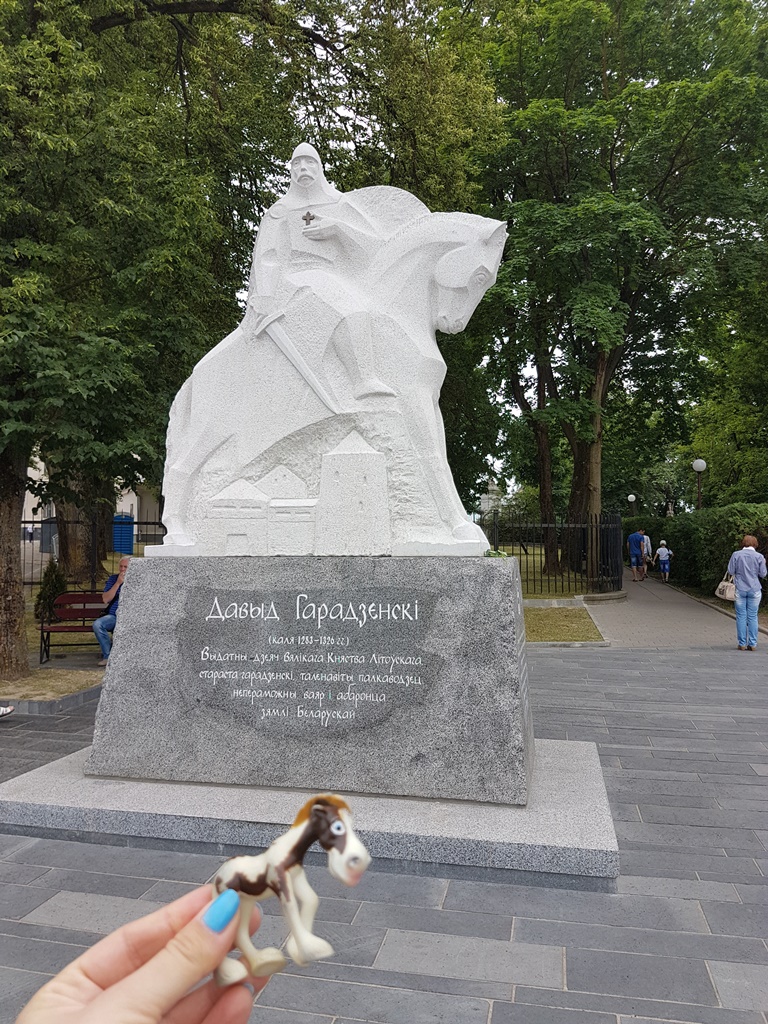
Just in front of the New Castle you can find two monuments. The first one presents David of Hrodna, the castellan of Hrodna and one of the most famous military commanders of Gediminas, Grand Duke of Lithuania in the first half of the fourteenth century.


The second one commemorates another famous hero, the Lithuanian Grand Duke Vytautas. He was the prince of Grodno from 1376 to 1392, and he stayed there during his preparations for the Battle of Grunwald.


In sixteenth century, the Grand Duchy united with Kingdom of Poland to create The Commonwealth of Two Nations. The most beautiful sacral building in Grodno was built soon after it under huge influence of the Polish culture. Ladies, gentlemen & horses, please admire the St. Francis Xavier Cathedral.


It has survived World War II with no serious damage, but in 1960 it was officially closed for public religious services for 27 years. The communist authorities tried to convert the building into a museum or a concert hall. Despite this, people attended the church every Sunday for a common player, songs and rosary. The religious services were restored in 1987 and in 1991 the church became a cathedral for a newly created diocese of Grodno.


It is very similar to Holy Cross Church in Warsaw, including the Statue of Christ Bearing His Cross before the church.


But the main altair is more impressive in Grodno.


Towards the end of the eighteenth century, the city became a part of the Russian Empire. From this period originates another landmark of Grodno, a fire station with a tower built in the early twentieth century. This fire station is still operational and fulfils its main function.


Then after World War I, Grodna found itself in the boundaries of the Second Polish Republic. But only twenty years later came the World War II. Although I am proud of all the horses that won the battles, I am also happy that we horses can now live peaceful life, since there is a new cavalry. Like the one below, on the monument to commemorate the liberators.


After 6 years of war the city became part of Soviet Union. This spectacular building is Grodno Region Drama Theater. It is the contemporary symbol of the city. Have you noticed the muses on the horses ?


Much more impressive than the contemporary Town Hall.


In 1990 Belarus declared itself sovereign. The city is very green, with many artificial water reservoirs.


Quite often one can find also beautiful sets of flowers, like here in front of Basilian Nuns Monastery.


And this obelisk is the starting point all from which the distance from Grodno to other cities is provided. So you can say we are just in the city center. Do you see the tents behind ? I will show you their content next week.


Saturday, 11 March 2017

Museum of Russian Airborne Forces

I love travelling. And soldiers also do. And they also like to make a surprise and come unexpectedly from the sky where and when nobody awaits them. On parachutes. And since they are like born from the air, they are called Airborne Forces.


Let's see the ones born from the sky in their museum in Ryazan, just next to the school where all Russian paratroopers are trained.


In most countries the parachutes are quite small and they can carry only soldiers or small light cars, or small cannons like ZIS-3, with barrel caliber 76 mm.


Or anti-tank cannon like SD-57, with barrel caliber 57 mm, which used to be sufficient to make a hole in tank during WWII (or as they call it in Russia - The Great Patriotic War).


Or M-30 howitzer, that is a short barrel cannon to shoot high, for example over mountains.


Or a small anti-aircraft cannon like this ZU-23, used in 2 barrels version even now.


But Russia is a huge country. And everything in Russia is huge. So Russian troops have also huge parachutes and they can carry even heavy armoured infantry fighting vehicles.


The first airborne infantry vehicle was constructed in Russia in 1967 and is called BMD-1


It looks like a small tank, has a turret with cannon calibre 76 mm and can carry up to 7 soldiers. But it must be light enough for a parachute so it's armour is much thiner that in tanks and protects only against small arms fire and shrapnels. The improved version is called BMD-2.


The most impressive object for me is a self-propelled gun SU-85.


Unfortunatelly they do not offer parachute jumps in the museum. Or may be it is even good, I am not sure I would be brave enough. Would you ?