Today, I will talk you to Mount Przemysław in Poznań.
On top of the hill you will find a castle.
Those of you who are good in the history of the architecture will quickly scratch their heads, trying to figure out how old this castle is. Well, it is less than 20 years old to be honest. It has been reconstructed at the beginning of the twenty first century but its design is eclectic in many ways. Actually, historians say that a castle like this one has never been (and could have never been) standing on this hill. But someone decided that Poznan deserves a royal castle and here it comes.
Inside, you will fid the Museum of Applied Arts.
Inside, you will recognise some gothic-style arches.
But some of the rooms are decorated in tapestries that have little to do with Middle Ages.
In the armory you can admire the fire weapons from different periods.
But my favourite exhibit in the armoury is this fancy outfit, collected in the Vienna battlefield in 1683.
Just next to the armoury you will find the Kunstkamera which used to be a kind of private museum, compiling items that were a proof of the wealth and wide interests of the owner. It included natural wonders, called naturalia ...
... and man-made wonders, including scientific instruments.
The museum holds a collection of items inspired by China. And next to it you will find a piano with decoration motifs from what seems to be an English shire. Not only the walls of the castle are eclectic...
A museum of applied arts need to have a collection dedicated to fashion. While my human secretary loved this part ...
I think I would chose this outfit. It was tailor made for a wealthy Polish noble, most probably from seventeenth or eighteenth century.
If you prefer something more exotic, you always opt for the samurai instead.
The royal castle of Poznan has one more thing to offer. But we need to earn it by climbing some stairs (the lazy ones can use the elevator).
From the top of the tower we can admire a panorama of Poznan. Do you recognise the Town Hall?
Let's walk to the other side.
Here you can see the fire station next to the city walls that we have passed by last week.
They say that no king has ever lived in the royal castle in Poznań. Well, they are probably right. I still liked it quite a lot. Far better than another cubic structure made of metal and glass. And the crown fits particularly well.
But no worries. Next week I will take you to a place where a real king is still present.
Showing posts with label Castle. Show all posts
Saturday, 8 June 2019
Saturday, 10 November 2018
Slane
Just 7 kilometers to the West from Newgrange, on the same side of Boinne river, there is a beautiful castle. It has been the family seat of the Conyngham family since it was built in the late 18th century, on land first purchased in 1703 by Brig.-Gen. Henry Conyngham, after it was confiscated from the Flemings, Anglo-Norman Catholics who had aligned themselves with the Jacobites in the War of the Grand Alliance, and thus after the Williamite victory lost their property.
But since there are less horses now than earlier, part of the stables were converted in the Slane Irish Whiskey Distillery.
Ladies, gentlemen, horses, let's go inside and see how something better than Guiness is created.
On the picture below you can see the first stage of the process - the barley malting.
To start the process you need the best barley, like the one growing on the castle fields just around.
After harvesting we need to collect all the grain.
Add the water and wait a bit.
After pouring out the water ...
we will see the rootlets meaning the seeds started to produce sugar.
Now we can start "kilning" which means drying in a special oven.
Next stage is milling, that allows to separate external part of seeds from its content that we need to use in further process.
Here comes the mill.
And its output.
Unfortunately taking photos is forbidden in the places where next stages of the process happens, so you can only analyze the below scheme to understand the brewing, fermentation and distillation. The product of all the stages on the scheme is the spirit consisting in over 90% of alcohol, so way too strong to be drunk.
You can just admire the distillery from outside.The metal pipes are used to cool down the alcohol during the destillation.
Up to this stage, the manufacturing process for vodka and whiskey is in fact very similar, maybe except that vodka is rather not produced from barley. But what make the great difference in the flavor is what happens further and is called casking.
Casking means allowing the whiskey to spend time in casks (which means barrels). Irish whisky requires at least 3 years and one day to be certified, one day more than Scottish.

What makes Slane Whiskey special is that it is triple casked, what means the whiskey spends time in 3 types of barrels: Virgin (not used previously) and Seasoned casks raised by hand at the venerated Brown-Forman Cooperages, and Oloroso sherry casks by way of Jerez in Spain.
Once the liquid has been aged to perfection, it is masterfully blended to create an exceptional Irish whiskey. Virgin casks contribute flavours of toasted Oak and vanilla. Seasoned barrels of Tennessee whiskey and Bourbon contributes flavours of caramel, plum, banana and butterscotch. Sherry casks contribute flavours of raisin and spice.
Let's now sit and try it.
Have you noticed the colour of a warm, golden topaz with hues of rich toffee ? If you smell it you will find a complex fruit aroma with drizzles of caramel, butterscotch, vanilla, brown spice and toasted oak. When you take your first sip, you will first find it spicy, but quickly sweetened with rich caramel, vanilla and butterscotch atop a deep layer of dried fruit. Even after you leave the bar you will still find the lingering hints of dry fruit and caramelised wood sugar.
Obviously every castle has its stable.
With my great ancestor monument I feel here like at home.
But since there are less horses now than earlier, part of the stables were converted in the Slane Irish Whiskey Distillery.
To start the process you need the best barley, like the one growing on the castle fields just around.
After harvesting we need to collect all the grain.
Add the water and wait a bit.
we will see the rootlets meaning the seeds started to produce sugar.
Now we can start "kilning" which means drying in a special oven.
Here comes the mill.
And its output.
You can just admire the distillery from outside.The metal pipes are used to cool down the alcohol during the destillation.
Up to this stage, the manufacturing process for vodka and whiskey is in fact very similar, maybe except that vodka is rather not produced from barley. But what make the great difference in the flavor is what happens further and is called casking.
Casking means allowing the whiskey to spend time in casks (which means barrels). Irish whisky requires at least 3 years and one day to be certified, one day more than Scottish.

What makes Slane Whiskey special is that it is triple casked, what means the whiskey spends time in 3 types of barrels: Virgin (not used previously) and Seasoned casks raised by hand at the venerated Brown-Forman Cooperages, and Oloroso sherry casks by way of Jerez in Spain.
Once the liquid has been aged to perfection, it is masterfully blended to create an exceptional Irish whiskey. Virgin casks contribute flavours of toasted Oak and vanilla. Seasoned barrels of Tennessee whiskey and Bourbon contributes flavours of caramel, plum, banana and butterscotch. Sherry casks contribute flavours of raisin and spice.
Let's now sit and try it.
Have you noticed the colour of a warm, golden topaz with hues of rich toffee ? If you smell it you will find a complex fruit aroma with drizzles of caramel, butterscotch, vanilla, brown spice and toasted oak. When you take your first sip, you will first find it spicy, but quickly sweetened with rich caramel, vanilla and butterscotch atop a deep layer of dried fruit. Even after you leave the bar you will still find the lingering hints of dry fruit and caramelised wood sugar.
Saturday, 13 October 2018
Dublin
I am so excited to take you today to yet another new country. It is widely known as the Green Island and as long as I have landed, I had no doubts why. It is indeed very green and close to the water.
Actually, in some parts they are maybe even overdoing it with the green.
I am sure by now you all have guessed that today we will visit Ireland. Or to be more precise, its capital city - Dublin. Since Dublin is a city with a long history, you will not be surprised that is has a castle.
Nowadays, the Dublin Castle is the sear of the Irish government. But it used to belong to a king of course. Though for centuries the title was held by the English kings who did not reside in Dublin but sent there their governonr instead. Maybe this is why the statue of the Justice is facing the castle rather than the nation gathered outside the main gate.
If I was an English king, I would not miss the opportunity to spend some time here. Even more, if I was a royal heir in shorts.
The gardens of the Dublin Castle hide one special place. In Garda Memorial Garden, completed in 2009, the names of all members of the Gardaí (Irish Police) killed in the line of duty are inscribed on a roll of honour.
The various sculptures are meant to remind the visitors that premature death tears families and society apart, leaving deep wounds.
Not far from the Dublin Castle, you will find the Irish parliament.
As we move on, we reach the Trinity College, founded in 1592 by Queen Elizabeth I .
Ireland witnessed in its history many religious turmoils. For many years, Catholics could not pass that gate. But today we can enter inside, irrespective of your confession.
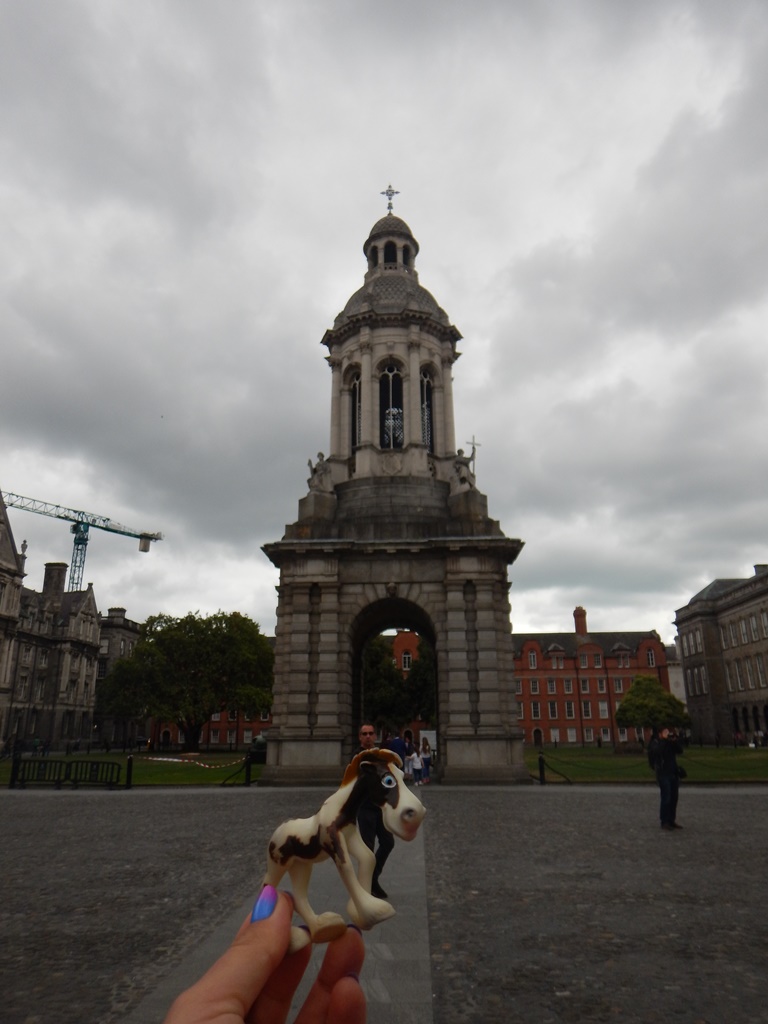
In the center of the College grounds you will find a bell tower called Campanile. Do not ask me why a university needs a bell tower, maybe to wake up students who snore too loudly during classes.
The Trinity College is considered the best university in Ireland. It is proud of its many famous graduates. One of them immortalised Dublin of his times in the famous book Ulysses. And Dublin pays back his honours to James Joyce by offering him a statue.
But Dubliners do not commemorate only people of distinguished talents. They have also made a monument for a common fishmonger called Molly Malone. You can easily see which part of the monument is the most appreciated one.
And if you do not know Molly, you need to turn the volume up.
As we move through the narrow streets ...
... we will reach the river Liffey. It is crossed by many bridges, some of which are for pedestrian traffic only.
On the other side of the river we need to take a look at the Spire of Dublin. If you have no clue what it represents and what is its connection to Dublin, you are likely to find many Dubliners of the same opinion. Though others say that the Eiffel Tower was hated for decades as well.
The Spire stands next to the main Post Office of Dublin (hello, my Postcrossing friends!).
I propose that we cross the river again. Those who wish can stay in one of the many pubs in the Temple Bar district.
Those who want to reconnect with the green side of the Green Island can join me into Stephen's Green, one of the city's many parks.
And next week, I will take you to one special place in Dublin, where Irish people celebrate the man who is painting the whole world green on one specific day of the year.
Actually, in some parts they are maybe even overdoing it with the green.
I am sure by now you all have guessed that today we will visit Ireland. Or to be more precise, its capital city - Dublin. Since Dublin is a city with a long history, you will not be surprised that is has a castle.
Nowadays, the Dublin Castle is the sear of the Irish government. But it used to belong to a king of course. Though for centuries the title was held by the English kings who did not reside in Dublin but sent there their governonr instead. Maybe this is why the statue of the Justice is facing the castle rather than the nation gathered outside the main gate.
If I was an English king, I would not miss the opportunity to spend some time here. Even more, if I was a royal heir in shorts.
The gardens of the Dublin Castle hide one special place. In Garda Memorial Garden, completed in 2009, the names of all members of the Gardaí (Irish Police) killed in the line of duty are inscribed on a roll of honour.
The various sculptures are meant to remind the visitors that premature death tears families and society apart, leaving deep wounds.
Not far from the Dublin Castle, you will find the Irish parliament.
As we move on, we reach the Trinity College, founded in 1592 by Queen Elizabeth I .
Ireland witnessed in its history many religious turmoils. For many years, Catholics could not pass that gate. But today we can enter inside, irrespective of your confession.
In the center of the College grounds you will find a bell tower called Campanile. Do not ask me why a university needs a bell tower, maybe to wake up students who snore too loudly during classes.
The Trinity College is considered the best university in Ireland. It is proud of its many famous graduates. One of them immortalised Dublin of his times in the famous book Ulysses. And Dublin pays back his honours to James Joyce by offering him a statue.
But Dubliners do not commemorate only people of distinguished talents. They have also made a monument for a common fishmonger called Molly Malone. You can easily see which part of the monument is the most appreciated one.
And if you do not know Molly, you need to turn the volume up.
As we move through the narrow streets ...
... we will reach the river Liffey. It is crossed by many bridges, some of which are for pedestrian traffic only.
On the other side of the river we need to take a look at the Spire of Dublin. If you have no clue what it represents and what is its connection to Dublin, you are likely to find many Dubliners of the same opinion. Though others say that the Eiffel Tower was hated for decades as well.
The Spire stands next to the main Post Office of Dublin (hello, my Postcrossing friends!).
I propose that we cross the river again. Those who wish can stay in one of the many pubs in the Temple Bar district.
Those who want to reconnect with the green side of the Green Island can join me into Stephen's Green, one of the city's many parks.
And next week, I will take you to one special place in Dublin, where Irish people celebrate the man who is painting the whole world green on one specific day of the year.
Subscribe to:
Posts (Atom)


