Showing posts with label Town Hall. Show all posts

Saturday, 1 June 2019

Old Town of Poznań

Poznań is the largest city in Western Poland. It has been founded in 1253 and for the next five hundred years it has been guarded by city walls.


Nowadays you can only see the ruins of the wall.


The building next to it is a fire station so you may say that it is a special place for the safety of the city also today.


I only hope that the fire brigade does not rely on these old fashion pumps.


If the walls would not be a protection enough, the people of Poznań made sure that they have two powerful guardians. They even put them in their coat of arms. And they did not chose modestly since they selected Saint Peter and Saint Paul.


Let's walk to the Market Square. It is surrounded by very nice residential buildings in vivid colours.


The most important building is of course the Town Hall, with its tall towers.


Now look carefully at the little door over the clock.


It is opening! And something is getting out of there!


These are goats!


And they do not seem too friendly to each other.


Around the Town Hall you can see several statues. Some are religious ...


... while others are definitely pagan.


In this building you will find the Museum of Literature.


Finally, a monument dedicated to a horse! It commemorates the fifteenth regiment of uhlans, the first regiment of cavalry in the Wielkopolska Uprising.


Though obviously, the most popular animal monument in Poznań is this one ...


Look at the clock on the wall, it is time that we move on.


Our next point of interest is round the corner. I will show it to you next week.


Saturday, 29 September 2018

Grand Place

Brussels is the seat of the central institutions of the European Union, so you could almost say that it is Europe's capital city. Inside this interesting city, as in many others, there is a central place. But this one is very unique. Ladies, gentlemen, horses - welcome to Grand Place! Although it is called Grand, it is not due to the size. The square measures just 68 by 110 metres (223 by 361ft) so it is 5 imes smaller from Krakow Market Square, but I have never seen such so many beautifully ornamented buidlings in one place.


As you can see it looks amazing in any weather.


The square was originally set up as Lower Market in the end of the 11th century, on a dried-up marsh near the fort that was surrounded by sandbanks.


On 13 August 1695, a 70,000-strong French army under Marshal François de Neufville, duc de Villeroy, began a bombardment of Brussels in an effort to draw the League of Augsburg's forces away from their siege on French-held Namur in what is now southern Belgium. The French launched a massive bombardment of the mostly defenseless city centre with cannons and mortars, setting it on fire and flattening the majority of the Grand Place and the surrounding city. Only the stone shell of the town hall and a few fragments of other buildings remained standing. That the town hall survived at all is ironic, as it was the principal target of the artillery fire.


The square was rebuilt in the following four years by the city's guilds. Their efforts were regulated by the city councillors and the Governor of Brussels, who required that their plans be submitted to the authorities for their approval. This helped to deliver a remarkably harmonious layout for the rebuilt Grand Place, despite the ostensibly clashing combination of Gothic, Baroque and Louis XIV styles.


In the late 18th century, Brabant Revolutionaries sacked the Grand Place, destroying statues of nobility and symbols of Christianity. The buildings were neglected and left in poor condition, with their facades painted, stuccoed and damaged by pollution. By the late 19th century, a sensitivity arose about the heritage value of the buildings – the turning point was the demolition of L'Étoile guild house in 1852. Under the impulse of mayor Charles Buls, the Brussels' authorities had the Grand Place returned to its former splendour, with buildings being reconstructed or restored.


Let's go around the square. Each of the houses has its name. Let's meet, from left to right: Le Mont Thabor, La Rose, L'Arbre d'or, Le Cygne and L'Étoile, where you can find the passage for a horse-drawn tramway. Good to know something was done here especially for us, horses.


The Town Hall is the central edifice on the Grand Place. It was built between 1402 and 1455 and it is the square's only remaining medieval building. The Gothic tower is 96 m (315 ft) heigh. At its summit stands a 5 m (16 ft) tall statue of Saint Michael, the patron saint of Brussels, slaying a demon.


Going further clockwise we have Le Renard, Le Cornet, La Louve, Le Sac, La Brouette and at the end Le Roy d'Espagne, decorated with bust of Charles II of Spain, last Habsburg ruler of Spanish Empire. Please remember that from 1506 to 1713 Brussels and whole Southern (Catholic) Netherlands were part of the Spanish Empire.


Below we have the north-eastern fasade, with very impressive house that used to have the different names: Bread House (by 15th century), Duke's House (when it was the seat of Duke of Brabant) and King's House later.


Here you can admire it in its full beauty.


Let me introduce you to: Le Marchand d'or, Le Pigeon, La Chaloupe d'or, L'Ange, Joseph et Anne, Le Cerf. The last one houses fantastic shop of Godiva. You should try it!


And the last one: House of the Dukes of Brabant, in fact joining seven houses into one common facade.


The Grand Place was named by UNESCO as a World Heritage Site in 1998.


Let's see what is behind the facades.


It is also beautiful and impressive.


Next week I will show you other interesting parts of the capital of the EU.

Saturday, 14 July 2018

Grodno

Welcome to Grodno, “The Pearl of the Neman Region”. The city is located on Neman river, whose basin covers huge part of Belarus, Lithuania and Kaliningrad oblast of Russia. It used to be the central river of Grand Duchy of Lithuania and the city used to be one of the crucial municipalities of the Duchy.


Let's start with oldest tourist attraction: the old Grodno Castle. The first stone fortifications were erected on the site of the castle in the twelfth century. After that, the castle was repeatedly destroyed, rebuilt and reconstructed. Recent significant changes in his appearance were made in the nineteenth century.


Until the second half of seventeenth century there used to be a wooden bridge here, leading to the castle gate.


Apart from the main gate, only ruins remain of the mediaval walls until our days.


If the city has an Old Castle, you must have guessed that there exists also a New Castle. It is also an important landmark of Grodno. It was built directly next to the Old Castle in 1742. Although it is called a castle, it has never fulfilled the defensive functions, but used to be a royal palace.


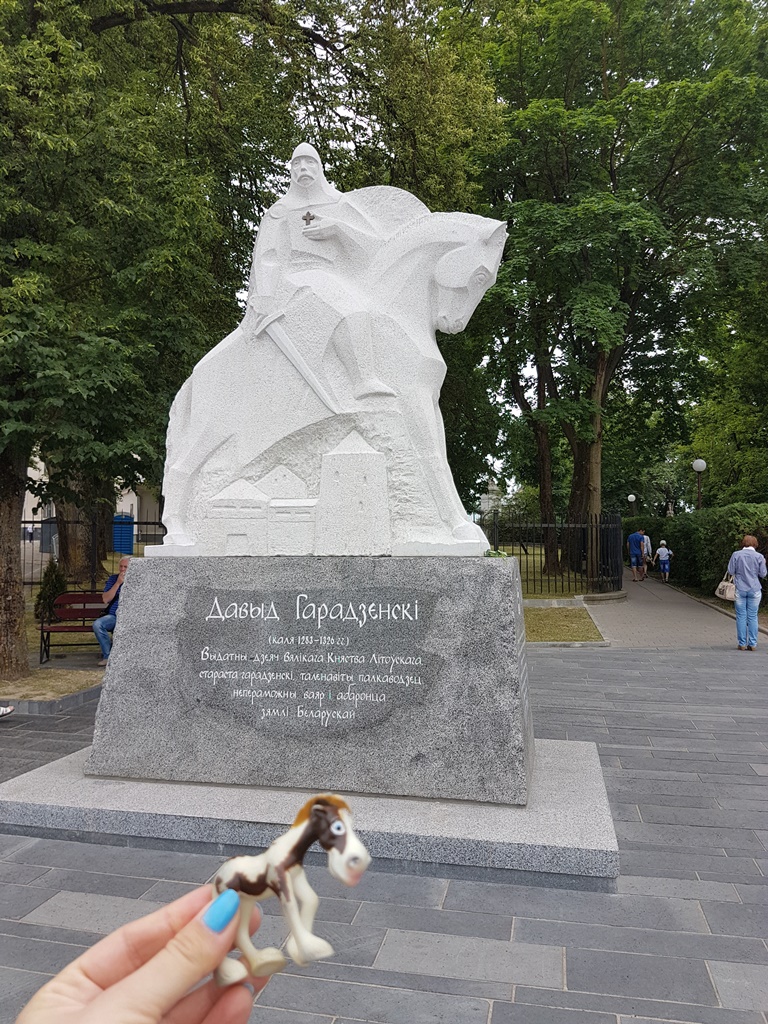
Just in front of the New Castle you can find two monuments. The first one presents David of Hrodna, the castellan of Hrodna and one of the most famous military commanders of Gediminas, Grand Duke of Lithuania in the first half of the fourteenth century.


The second one commemorates another famous hero, the Lithuanian Grand Duke Vytautas. He was the prince of Grodno from 1376 to 1392, and he stayed there during his preparations for the Battle of Grunwald.


In sixteenth century, the Grand Duchy united with Kingdom of Poland to create The Commonwealth of Two Nations. The most beautiful sacral building in Grodno was built soon after it under huge influence of the Polish culture. Ladies, gentlemen & horses, please admire the St. Francis Xavier Cathedral.


It has survived World War II with no serious damage, but in 1960 it was officially closed for public religious services for 27 years. The communist authorities tried to convert the building into a museum or a concert hall. Despite this, people attended the church every Sunday for a common player, songs and rosary. The religious services were restored in 1987 and in 1991 the church became a cathedral for a newly created diocese of Grodno.


It is very similar to Holy Cross Church in Warsaw, including the Statue of Christ Bearing His Cross before the church.


But the main altair is more impressive in Grodno.


Towards the end of the eighteenth century, the city became a part of the Russian Empire. From this period originates another landmark of Grodno, a fire station with a tower built in the early twentieth century. This fire station is still operational and fulfils its main function.


Then after World War I, Grodna found itself in the boundaries of the Second Polish Republic. But only twenty years later came the World War II. Although I am proud of all the horses that won the battles, I am also happy that we horses can now live peaceful life, since there is a new cavalry. Like the one below, on the monument to commemorate the liberators.


After 6 years of war the city became part of Soviet Union. This spectacular building is Grodno Region Drama Theater. It is the contemporary symbol of the city. Have you noticed the muses on the horses ?


Much more impressive than the contemporary Town Hall.


In 1990 Belarus declared itself sovereign. The city is very green, with many artificial water reservoirs.


Quite often one can find also beautiful sets of flowers, like here in front of Basilian Nuns Monastery.


And this obelisk is the starting point all from which the distance from Grodno to other cities is provided. So you can say we are just in the city center. Do you see the tents behind ? I will show you their content next week.