Saturday, 12 November 2016

Lucerne (2) or Rick the Submarine

Last post on the blog ended dramatically, probably even in a worst moment than on the day when pirates have kidnapped Rick. Luckily, one of our faithful readers came to Rick's rescue, building a special device to literally fish Rick out of the river.


Hi everybody! It's me, Rick! Thanks for all those who have contributed to the rescue mission. I was already starting to fear that I will spend the rest of my life in this cold river. I admit, the view would be spectacular since I have landed just next to Lucerne's biggest tourist attraction, the Chapel Bridge. In the back you can see Pilatus.


The Chapel bridge is amazing for more than one reason. It is diagonal, meaning it is not passing the river in the shortest way. It is a pedestrian pass that is made of wood and that is covered - actually it is one of the oldest wooden covered bridges in Europe. It is also the longest truss bridge in the world. Trusses are construction elements in the form of triangles.


 Inside the triangles come paintings showing the history of Lucerne.


 From the bridge we can see the old town and the Town Hall.


On 18 August 1993 a huge fire broke, almost destroying the bridge.

Source: www.20min.ch

As a result, 75% of the paintings were destroyed. The bridge and the paintings were subsequently restored. Now they look as new. Or as old to be more precise.


The tower in the middle is actually not a chapel. It is a water tower, that used to be a prison as well. Nowadays it is closed to the public.


Did you notice the white building on top of the hill? It is Château Gütsch. It was built in 1888 by architect Emil Vogt as a private residence. Nowadays it is a five star hotel.


It was a long and exhausting day. Time to go back to the train station. Next to it you can find the Lucerne Museum of Art.


The Lucerne railway station was heavily impacted by the fire that burnt the Chapel Bridge. Nowadays only the former facade has survived, forming an arc of triumph leading to the new and modern station building.


Finally, we need to leave the heart of the old town and take a look at the Dying Lion of Lucerne. It was carved out of natural rock in memory of the loyalty and bravery of the Swiss mercenaries who died when protecting the French kind Louis XVI at the Tuileries in 1792. Mark Twain described the Lion of Lucerne as the saddest and most moving piece of rock in the world.


The Lion of Lucerne, sometimes linked with Aslan from "The Chronicles of Narnia", is a good summary of my trip to Lucerne. I must say that today I have witnessed a rainbow of feelings, going from despair to hope and enthusiasm. Lucerne will forever have a special place in my hearth.

Saturday, 5 November 2016

Lucerne

The city of Lucerne is the capital city of the canton of Lucerne (and yes, Swiss people are really thrifty with geographic names). Its old town is made of residential buildings, many of which are painted in bright colours. 


The nicest are located around the Sternenplatz, that exists since mid-thirteenth century. Its name means literally star-square and refers to a number of streets that meet there. It is further supported by the picture on the pavement.


Some of the painted facades imitate additional architectural elements like windows ...


... while others include only ornaments.


Lucerne lies on the shore of (yes, you guessed it right) Lake Lucerne, that we have seen from the top of Mount Pilatus. The old town is located on two banks of the river Reuss that leaves the Lake. On one bank you can see the Jesuit church, built in baroque style in the seventeenth century.


Just on the opposite side you will find the Town Hall.


The dome in the back is the Town Hall Tower.


But the city of Lucerne is mainly famous for its bridges. Or rather one special bridge. Let's return to the Reuss river and have a closer look at it.


Oh no! What are you doing?! Be careful! I did not mean THAT close!

* * *

Dear Readers, it is a disaster! Rick has just slipped of my hand and landed in the Reuss river, a few meters below the street level.


It seems like this is the last story on our blog, unless any of you is a professional (and fully equipped!) diver. Then please come to Lucerne as soon as possible. The water is really cold. 


Saturday, 29 October 2016

Bergwerk Käpfnach

Today we will take a tour in a place out of common. Let me invite you to a special visit in the Bergwerk Käpfnach, a genuine coal mine located in the picturesque town of Horgen, on the shores of the Zurich Lake.


Nowadays, most of Swiss energy consumption is covered with nuclear and hydro power. Therefore, coal mines like the one in Horgen are no longer needed. They remain however witnesses of the industrial heritage of the region.


The entire area of the Käpfnach coal mine is large, including around 80 kilometres of tunnels below the Zimmerberg mountain.


To move the coal around such area man needed help. I have heard that in some coal mines they used horses to do this work! How outrageous. I did not receive a clear answer how these wagons were moved around, but looking at their weight I can only trust this was steam power or electricity.


Look, here comes a little model of the mine. This definitely looks like a locomotive. What a relief, no horses were harmed here my friends. We can get in!


First we can take a look at the overground museum, where different types of coal are exhibited. In the Käpfnach mine the so-called brown coal was mined.


But looking at artefacts in a museum is no fun. So let's jump on the red train called Barbara. Saint Barbara is the holy patron of miners, who celebrate with great care her day, being 4th December. The inscription on top of the tunnel says "Glück auf!" which is a traditional greeting of German-speaking miners, expressing a wish for successful mining and safe return on the ground.


The little red train will take us inside the tunnels that used to be production lines. They are narrow just enough to accommodate the train, so you can literally touch the walls next to you.


They are also low, so helmets are a must.


The brown coal is not really brown. But it is also not black like the charcoal you would normally have in mind when thinking of a mine.


The layer of coal in Käpfnach is only one meter tall, which you can clearly see here.


Did you notice the thermometer? Do you have any idea how many centigrade are here? Less than ten in fact.


Do not be surprised, after all we are 500 meters below ground level.


I think that you are staring to realise that mining in a place like that was not a piece of cake. It was dark, cold and narrow. The miners were digging the coal out lying on the floor, in a hole that was just about one meter high.


Then, they were putting the coal into the mining wagons so that it is brought up.


The Käpfnach mine was mainly used during war time. First during the French-Prussian war in 1870, then during the First and Second World War. It was finally closed in 1947. A group of enthusiasts keeps the memory of the old times by introducing tourists to the hard life of the miners.


I hope that you have enjoyed this unusual trip below the surface of the Earth. Now the last stage. Grab your carbide lamps and try to find your way out! Glück auf!"

Saturday, 22 October 2016

Pinewood Derby

Today we will have the chance to participate in the creation of something completely new and unique. I was offered the opportunity of participating in a pinewood derby! Pinewood derbies are a tradition of Cub Scouts of  Boy Scouts of America. The first derby took place in 1953. Not much has changed since. Each participant is getting the same box.


Inside you will always find the same kit - a block of pine wood, four plastic wheels and four nails that will become the axis.


How can you race a block of wood? Well, you need to work a bit on it. We need to prepare some tools.


First we need a saw and a set of clamps. We will cut the block in halves to improve the aerodynamics. Then we need to polish it well.


The heavier the car the better it races. The maximum weight is typically five ounces (150 grams). To get there, we will use some metal washers.


We will glue the washers with a hot glue gun. Then we can start painting.


Does it remind you of anything?


And yes, I told you. You can take a Polish guy out of Poland but you cannot take Poland out of a Polish guy. My human family not only painted the car in the colours of the Polish flag. They even called it "Winning Warsaw".


Time to go for the race! First, we need to register. Each car is carefully weighted.


Over seventy cars were registered for this derby.


Here comes ours!


The track starts high, since the cars are only moved by gravity. Then comes a long flat part.


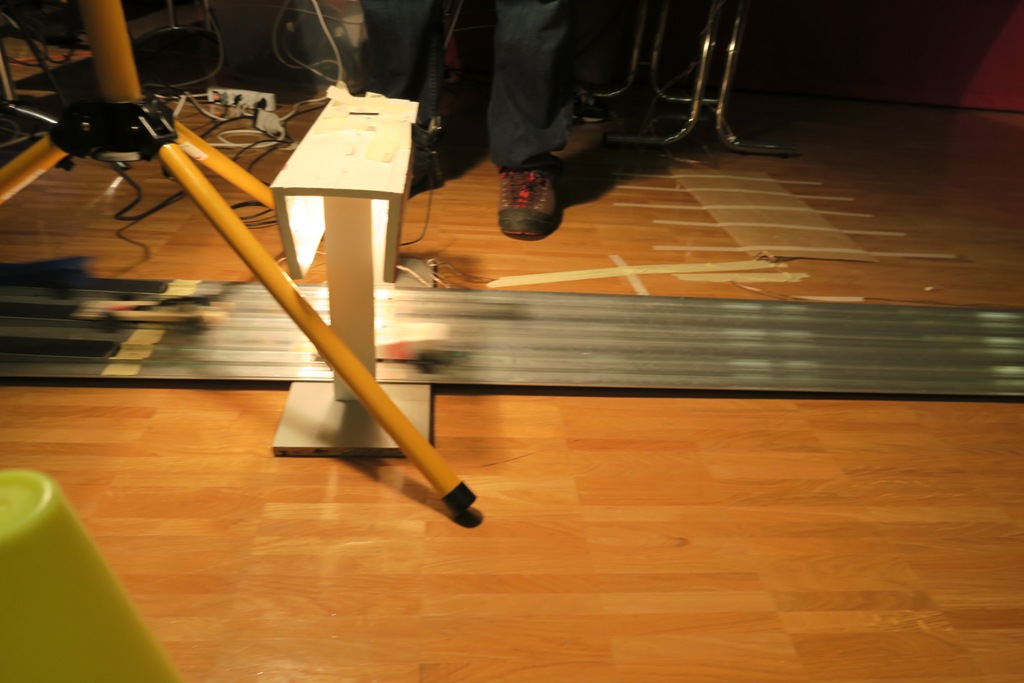
The track ends with sophisticated measuring devices that measure the time up till one ten thousandth of a second. On top comes a camera.


Winning Warsaw is ready to race.


Off they go! If you can hardly spot the cars do not worry. The average speed is around three hundred kilometers per hour!


Well, this time we did not win.


Still, the pinewood derby proved to be real fun. I hope that you enjoyed it as much as I did. And next year, we will build a better and faster car. I count on your help!