Saturday, 13 June 2015

Castle in Lublin

During our first winter visit to Lublin we only had a few minutes to see the Lublin Castle. I decided to spend more time there this time in order to allow you to see its rare beauty. Let's leave the Old Town again by the Grodzka Brama (City Gate). The inscription says it was built in MDCCLXXXV meaning 1785.


When walking on the bridge you can see a glimpse of the modern Lublin.
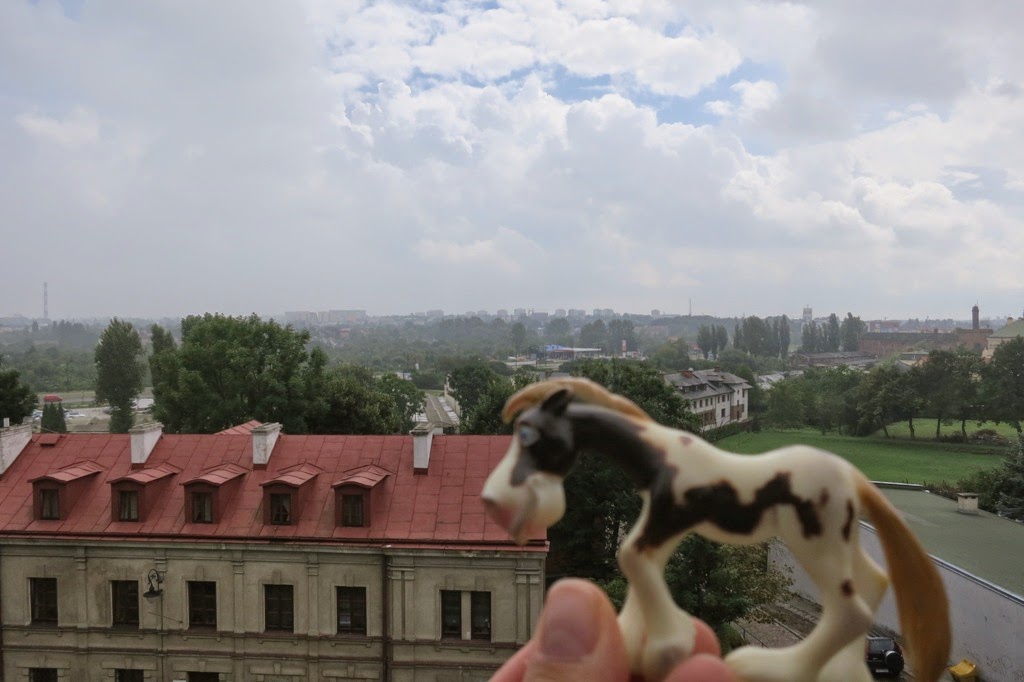

The path to the Castle is wide - in the past horse carriages had to move up the hill. Nowadays it is reserved for pedestrians. Can you spot the young couple in the back? Yes, brides in their wedding gowns are often seen here, it is a popular destination for wedding photo shoots.


The castle has a shape that reminds me of the Arabic architecture in the South of Spain. Do you also have this feeling?


Inside the courtyard looks more familiar. The Lublin castle was largely re-built by king Zygmunt Stary, based on designs of famous Italian architects. This was the same king whose Italian wife Bona Sforza has influenced the current shape of Wawel, the royal castle in Kraków. I see certain similarities.


In the middle of the courtyard you will find a large fortified tower called keep, built in Romanesque style


The white element on the top is called battlement. Originally it was meant as an additional defense tool. Nowadays it is mainly a "lacy" ornament. On top of the tower there is an observation deck.


The building in the back of the courtyard is the Chapel of the Holy Trinity.


This is the main reason why I decided to take you to the Lublin Castle for the second time. Does not look impressive? Just wait a moment. First, we need to walk through the regional museum located inside the castle. We can see some religious paintings ...


... and a few military paintings.


It is possible to see what the local men used when they were going to war, both in the Middle Ages ...


... and more recently.


It is also possible to admire the patience of their wives, translated into magnificent papercuts. I cannot say if I like more this one ...
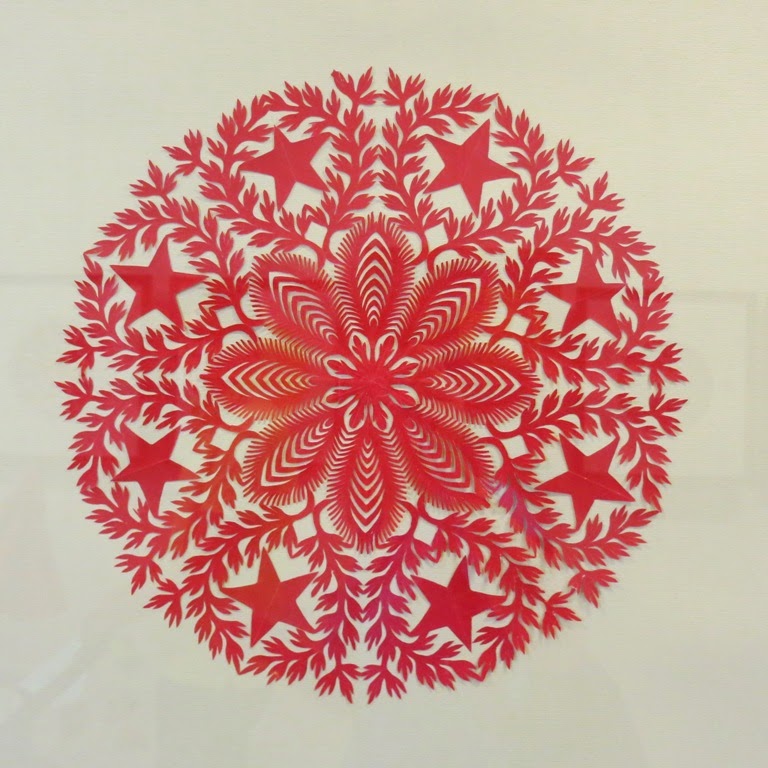

... or that one.


Finally I found it - the way to the Chapel.


The Holy Trinity Chapel was built in the fourteenth century. Władysław Jagiełło (yes, the one who defeated Teutonic Knights in Grunwald) has hired a famous local painter to decorate its walls. One thing that you need to know is that Jagiełło was a Lithuanian prince who married the heiress of the Polish throne. Until that day he was a pagan and so were all his subjects. He was baptised, together with the entire country, upon marrying Jadwiga and receiving the Polish crown. The paintings that he has commissioned are unique because they mix the Western and Orthodox style.


You can see there both scenes from the Holy Bible and some noble men.


The paintings cover not only the walls but also the pillars.


The gallery was meant to be a special place for the king himself.


Even though they are 600 years old, the paintings are in a really good shape.


The Chapel is, to my surprise, full of light. The gothic windows behind the main altar are narrow but high.


Next to the king's gallery, the windows are larger, allowing to see the inner courtyard.


I hope that you have enjoyed this tour of the Lublin Castle. I must admit that I was truely impressed by these Ruthenian paintings in the Holy Trinity Chappel - the brightness of the colours, the precision of the shapes, the amazing mix of Western style and Eastern mysticism. If I would be asked to propose a new Polish entry for the UNESCO Tentative list this would for sure be one of my first suggestions. What is your view about it?


Saturday, 6 June 2015

Old Town of Lublin

Today I will take you to the second biggest city on the left side of Vistula river. Those of you who read my blog for a longer time know that we have already visited Lublin. But in winter time we could not see its full beauty so I propose we spend a bit more time there. 

First traces of humans found by the archeologists in the surroundings of Lublin date five thousand years back. The name of Lublin first appeared in chronicles in 1198. But if you ask any Polish person what was the most important day in the history of Lublin they are likely to tell you it is 1 July 1569, when the Union of Lublin was signed, uniting Poland and Lithuania into one Commonwealth. This event is commemorated by an obelisk.


Next to it stands the monument of marshal Piłsudski. We talked about him already a number of times.


The monument of Józef Piłsudski, just like in Warsaw, you will find a monument dedicated to the unknown soldiers who perished fighting for freedom and justice.


 In the back there is a nice fountain.


It is facing the former Palace of the Lubomirski family. Today it belongs to the Lublin University.


Before we move on to the Old Town we need to make a little stop by the main Post Office.


My dear Postcrossing friends, I do rememeber about you!


When we were on Krakowskie Przedmieście in winter the street was empty. In summer time it is really crowded.


Many buildings are freshly renovated, with lots of nice cafes and restaurants inviting tourists.


Those who count every penny can always use the public water dispenser. The goat is in the coat of arms of Lublin.


But do not try to drink water from public fountains, no matter how pretty they are.


Finally we reach the end of Krakowskie Przedmieście and the New Town Hall. It was built in 1827 and serves as the seat of local government.


You probably remember the Kraków Gate, leading to the central part of the Old Town.


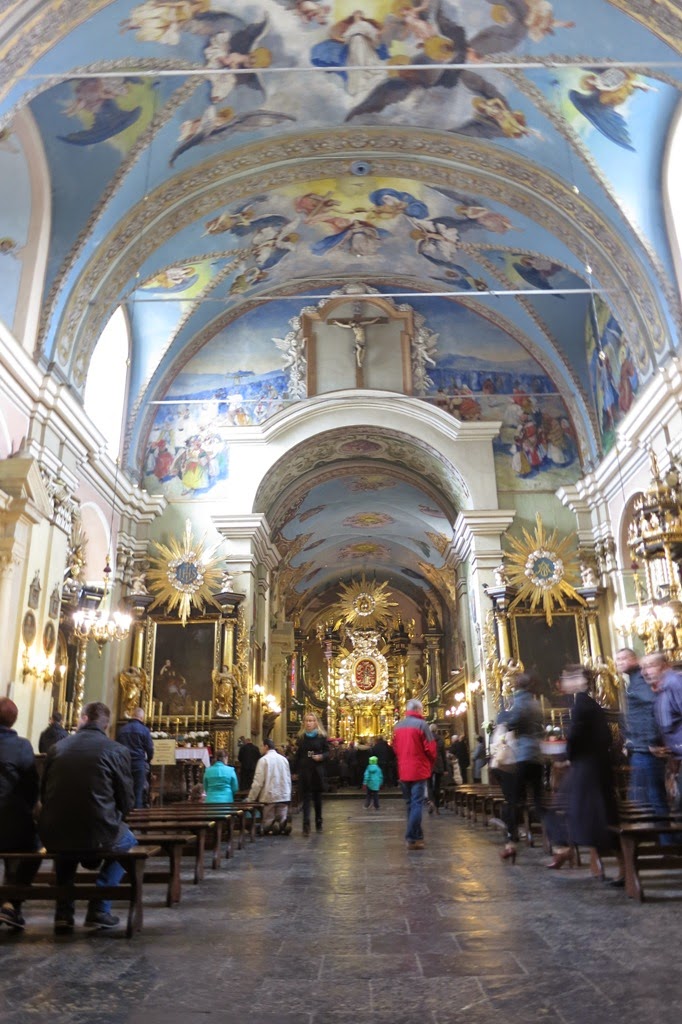
But before we take it we will go right to visit the Cathedral of Lublin. They wanted to devote it to Saint John but could not decide to which so it is devoted to both Saint John the Baptist and Saint John the Evangelist. It is built in baroque style.


 You can admire there a huge organ ...


 ... and an altar decorated with rich ornaments.


Time to move on to the Market Square. I really liked the residential buildings there.


In the middle of the square you will find the former Main Royal Tribunal, so the supreme court for Polish nobility between 1578 and 1795.


From the Market Square you can see the tower of the Kraków Gate ...


... and the Trinity Tower, the highest observation deck in town. Unfortunately horses are not admitted inside.


I know that this was a pretty long walk so I decided to stop here for the moment and find a nice place for lunch. We still need to see the biggest attraction of Lublin - its castle.

Saturday, 30 May 2015

Kalwaria Zebrzydowska

As you probably know Calvary (also known as Golgotha) is the hill in Jerusalem where Jesus was crucified. But since even with a horse it was not easy and very time consuming to get to Jerusalem, people built artifical Calvaries around the catholic world, especially in XVII century. The best preserved and the only one on UNESCO World Heritage List is Polish Kalwaria Zebrzydowska, near Kraków.


As you can guess Kalwaria is the Polish word for Calvary and Zebrzydowska comes from the name of its founder and first owner, Mikołaj Zebrzydowski, voivode of Kraków.

The biggest and central building of the area is a complex of basilica and monastery, with the monument of John Paul The Second, who has visited it many times.


Here is the main entrance to the sanctuary.


And this is the front of the baroque basilica of St. Mary of Angels.


It looks really impressive inside.


As typical for baroque there are many gold ornaments, for example on the pipe organs ...


and all around the tabernacle.


Here is the titular miraculous St. Mary's painting.


But there are things more impressive then gold, for example this wooden monastery choir ...


... in the St. Anthony's Chappel.


Just behind the basilica one can find the monastery of Bernardines.


And next to the monastery start the pathways.


They are really steep, full of stones and roots, to let the pilgrim imagine the effort Jesus made.


Amog the path there are many buildings imitating the important places from the passion route, like Pilate's palace, ...


Herod's palace, ...


Saint Veronica ...


in the center of the city,


the meeting with the women of Jerusalem, ...


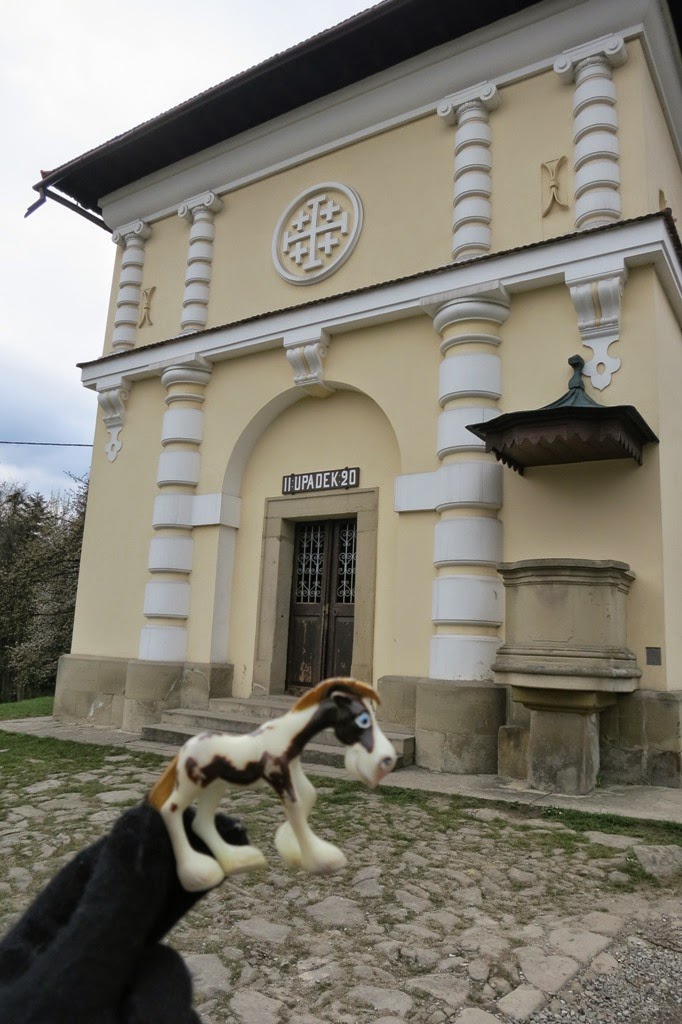
the second fall ...


with the sculpture inside, ...


the Jerusalem's gate ...


and the Crucifixion Church, ...


from where you can see the main complex.


The pilgrims who complete the route can rest here.


I really advise you to visit Kalwaria Zebrzydowska and feel in the legs (whether you have 2 or 4) Jesus' effort. Then you will understand the rationale for creating such places.