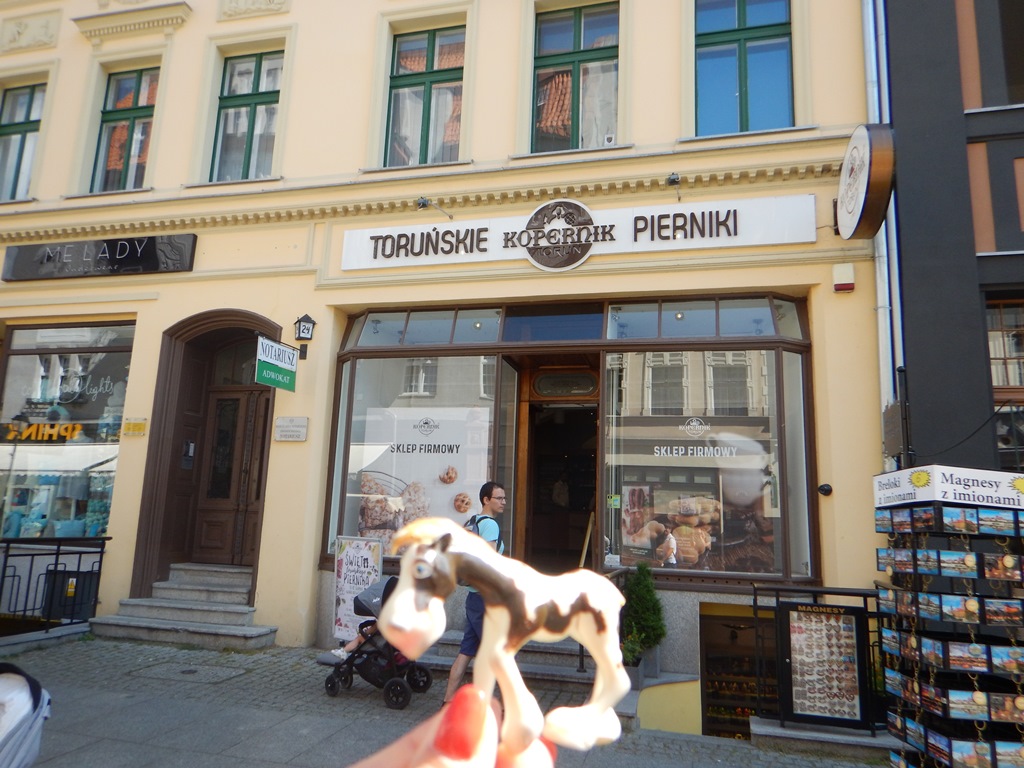
If you would ask a Polish person what Toruń is famous for, without any doubt they would first mention Kopernik. And in a second place they would most probably list pierniki or gingerbreads. You can see shops with gingerbreads everywhere. On your left ...

... on your right ...

... and in the middle. The most famous gingerbread maker is actually called Kopernik.

If you want to discover more about Toruń's gingerbreads, I would invite you to walk with me inside the Museum of Gingerbreads.

The first known recipe for Toruń's gingerbreads comes from eighteenth century. To make them, you need a pot, honey, water and a good measure of strong spirit. Then come the spices - ginger, cloves, cinnamon, nutmeg, pepper, cardamom, anise and lemon peel. And of course sugar. Finally comes the rye flour.

When you have the dough, all you need is a form. These can be simple ones. Those two shapes are actually the most popular ones.

The ones which look like six bubbles are called "katherines".

But the most famous gingerbreads have fantastic shapes. They can look like animals ...

... or like human beings.

It is almost impossible to stop oneself from trying to bite them. Actually it seems someone did lost that fight. But it was not me!

To make such amazing moulds you need a woodcarver. Or you can try yourself at home. The process of making a mould is three-step. First you need to choose the right piece of wood, usually an apple tree or a pear tree, without knots. Then you need to use tracing paper for an outline. Finally, you need to remove the wood to form the mould. Sounds easier than it is in reality. Woodcarvers are sought-for artisans with larger workshops.

Finally, we need to bake our gingerbreads in a large oven.

The last piece of the journey of a gingerbread is a gingerbread shop. In the nineteenth century it could have looked like that.

In the 1970s probably more like that.

Alternatively, you could buy them from a gingerbread-lady, walking down the streets of the Old Town.

I hope that now you know how to convert this ...

... into that.

Enjoy!


... on your right ...

... and in the middle. The most famous gingerbread maker is actually called Kopernik.
If you want to discover more about Toruń's gingerbreads, I would invite you to walk with me inside the Museum of Gingerbreads.

The first known recipe for Toruń's gingerbreads comes from eighteenth century. To make them, you need a pot, honey, water and a good measure of strong spirit. Then come the spices - ginger, cloves, cinnamon, nutmeg, pepper, cardamom, anise and lemon peel. And of course sugar. Finally comes the rye flour.

When you have the dough, all you need is a form. These can be simple ones. Those two shapes are actually the most popular ones.

The ones which look like six bubbles are called "katherines".

But the most famous gingerbreads have fantastic shapes. They can look like animals ...

... or like human beings.

It is almost impossible to stop oneself from trying to bite them. Actually it seems someone did lost that fight. But it was not me!

To make such amazing moulds you need a woodcarver. Or you can try yourself at home. The process of making a mould is three-step. First you need to choose the right piece of wood, usually an apple tree or a pear tree, without knots. Then you need to use tracing paper for an outline. Finally, you need to remove the wood to form the mould. Sounds easier than it is in reality. Woodcarvers are sought-for artisans with larger workshops.

Finally, we need to bake our gingerbreads in a large oven.

The last piece of the journey of a gingerbread is a gingerbread shop. In the nineteenth century it could have looked like that.

In the 1970s probably more like that.

Alternatively, you could buy them from a gingerbread-lady, walking down the streets of the Old Town.

I hope that now you know how to convert this ...

... into that.

Enjoy!


