I will take you today on a little walk in London. If you expect to see Big Ben or the London Eye, you might be a bit disappointed. Because we will walk around the Paddington area within the City of Westminster, in central London. We will start, not surprisingly, at the Paddington railway station, where you can arrive directly from Heathrow on the Heathrow Express (expensive but really fast).

The Paddington area does not have a central point of its own. Instead it is composed of residential buildings, hotels and small parks. One of the most noticeable public buildings is the St. Mary's hospital.

If you do not want to visit it from the inside, remember one critical instruction: the cars in England move on the left side of the road. So when you cross the street ....

The St. Mary's Hospital stands next to a little canal. It is the Paddington Arm of the Grand Union Canal.

To keep the canal clear of algae and to aerate it, a special "bubbly barrier" was created.

At the very end of the canal comes the Merchant's square. It used to be a kid of market place in the past but today it is a residential and leisure area.

On sunny days, children most probably play by (or in...) the fountain.

Supervised by sir Simon Milton, a former leader of the Westminster City council.

Close to the St. Mary's hospital stand the St. Mary's church in the parish of Little Venice.

Behind it you will find a small park, called St. Mary's churchyard. Very pragmatic.

But before you start running and having fun here, maybe you should take a closer look at the fence. Or at the stones standing by the fence. And yes, this are tombstones.

The churchyard is a former graveyard. Still some bigger graves remain in the middle of the lawn.

To be honest, I find the idea quite spooky. But apparently other people not, since there are residential buildings surrounding the yard.

Not forgetting the City of Westminster College.

In the St. Mary's churchyard you will find graves of some famous people, like Sarah Siddons, the best Lady Macbeth of her times.

Luckily, the Paddington area has also other parks to offer, like the Norfolk square.

Inside, you will find cosy lanes and an abundance of plants.

Let's take a walk inside.

I would expect that flats in the buildings facing the Norfolk Square are more expensive that I can even imagine.

I propose that we take a break and order a pint in one of the pubs. This one looks really welcoming. Maybe they have some good Sherlock Holmes stories to share.


The Paddington area does not have a central point of its own. Instead it is composed of residential buildings, hotels and small parks. One of the most noticeable public buildings is the St. Mary's hospital.

If you do not want to visit it from the inside, remember one critical instruction: the cars in England move on the left side of the road. So when you cross the street ....

The St. Mary's Hospital stands next to a little canal. It is the Paddington Arm of the Grand Union Canal.

To keep the canal clear of algae and to aerate it, a special "bubbly barrier" was created.

At the very end of the canal comes the Merchant's square. It used to be a kid of market place in the past but today it is a residential and leisure area.

On sunny days, children most probably play by (or in...) the fountain.

Supervised by sir Simon Milton, a former leader of the Westminster City council.

Close to the St. Mary's hospital stand the St. Mary's church in the parish of Little Venice.

Behind it you will find a small park, called St. Mary's churchyard. Very pragmatic.

But before you start running and having fun here, maybe you should take a closer look at the fence. Or at the stones standing by the fence. And yes, this are tombstones.

The churchyard is a former graveyard. Still some bigger graves remain in the middle of the lawn.

To be honest, I find the idea quite spooky. But apparently other people not, since there are residential buildings surrounding the yard.
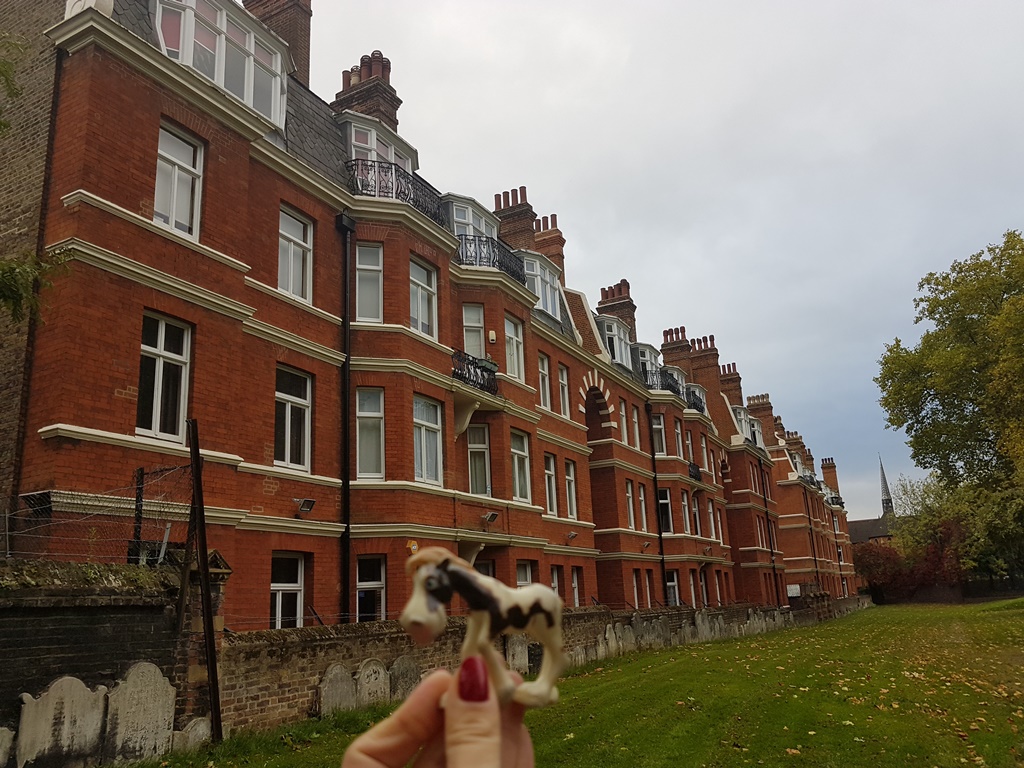
Not forgetting the City of Westminster College.

In the St. Mary's churchyard you will find graves of some famous people, like Sarah Siddons, the best Lady Macbeth of her times.

Luckily, the Paddington area has also other parks to offer, like the Norfolk square.

Inside, you will find cosy lanes and an abundance of plants.

Let's take a walk inside.

I would expect that flats in the buildings facing the Norfolk Square are more expensive that I can even imagine.

I propose that we take a break and order a pint in one of the pubs. This one looks really welcoming. Maybe they have some good Sherlock Holmes stories to share.


