Showing posts with label France. Show all posts

Saturday, 17 September 2016

Neuf-Brisach

I wonder how many of you are able to pronounce correctly the name of the town we will visit today, Neuf-Brisach. I know, I know, it is not easy. Still, we cannot allow it to discourage us from visiting a unique piece of architecture and urbanism, one of the sites designed and built by the French military engineer Sébastien Le Prestre de Vauban who served Roi Soleil, king Louis XIV. Its construction started in 1699 which means that the town has celebrated its 300 anniversary not so long ago.


The universal values of the Vauban Fortifications was recognised by UNESCO who inscribed twelve of them (including Neuf-Brisach) on the World Heritage Sites List.


The fortified town was intended to guard the border between France and the Holy Roman Empire and, subsequently Germany. It is surrounded by a double moat delineated by city walls.


The inner moat is now used for an art exhibition. At least this is my assumption, unless these wooden piles are a sophisticated means of defence.


To enter the city, visitors need to take one of four gates in the fortifications. This one is called Porte de Colmar or the Gate of Colmar, since it faces the city of Colmar. It was probably a very smart design at the end of the seventeenth century but nowadays only one car can pass by the gates and the move of pedestrians is neither easy nor safe.


Once you stand at the porch, you can realise the protective value of the Vauban fortifications. The walls have several meters of depth.


When I entered into the town, I was almost disappointed. Neuf-Brisach proved to be just a small French town like any other.


In the middle you can find of course the market square. As you have noticed, it is quite large, which is part of the Vauban design, to protect the houses in case of cannon fire.


The church on the market square is dedicated to Saint Louis, the saint patron of Vauban's boss.


The layout of Neuf-Brisach was that of an ideal city, similar to Zamość which I have shown you some time ago. It has a regular square grid street pattern inside an octagonal fortification.

Source: wikipedia.com

Unfortunately, it is not easy to appreciate it standing on the ground, it is only from bird-eye view that you can realise in full the amazing design that was brought to life by Monsieur Vauban. A real genius in my view.
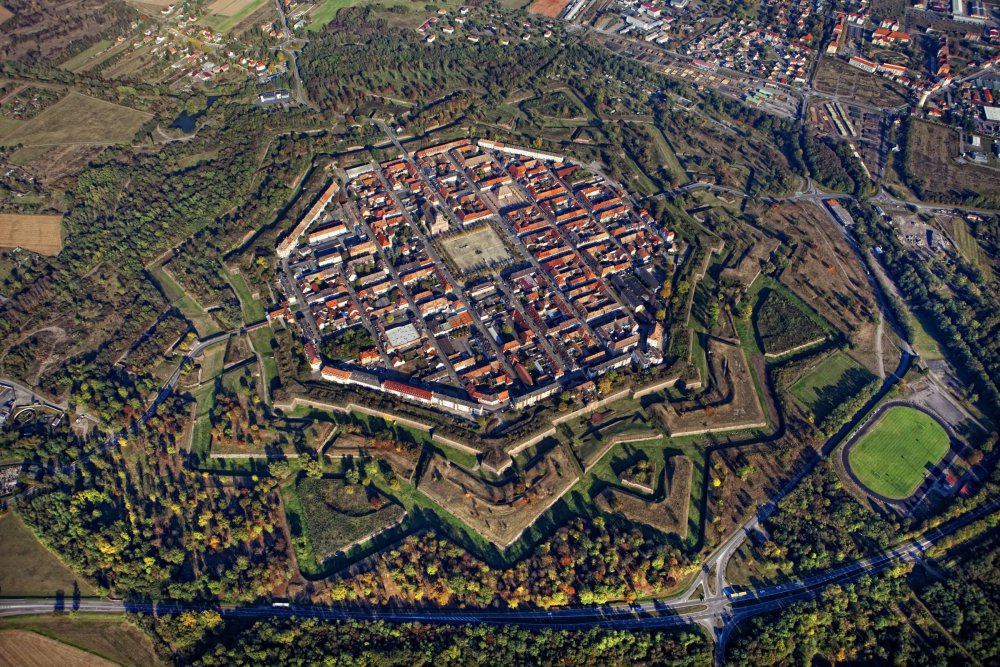
Source: www.upperrhinevalley.com

Saturday, 21 December 2013

Argonaute

We horses, swim quite well in rivers. Nevertheless almost all of us, being in the water in our childhood, dream about changing into a seahorse, to submerge and dive into the deepest levels of the ocean. Being in the Paris I understood that this type of dream is also known to people and they even managed to realize it, at least partially.


During my visit in the Cité des Sciences et de l'Industrie I have noticed from inside a big, long, black object outside. I was told that it is a naval submarine Argonaute, which after the end of her naval duties was given another important job - to present the life on a submarine to the civilians.


Before stepping in, we could see what parts she is composed of: Going from the aft (the back in maritime language) there is the rudder and the propeller, the backwards berth, the electrical engine section (which by the shaft is connected to the propeller), the diesel engines and generators charging the batteries. Then on the lower deck there are very heavy batteries and on the upper level the control rooms and at the bow the forward torpedos launch tubes.


The aft berth looks exactly as above. As you can see there is not much privacy there, especially that most of bunks are used by many seamen - one sleeps when another one is on duty. Now I sleep and you are on duty :).


It is not easy to control a submarine. It is more difficult then to control a car and similarly difficult as to control a horse. Because you can go left, right, up and down and additionally control the trim (whether you are horizontal, for example when all the crew is in the bow). To achieve this you must use all the controls on the picture above, since there is no saddle and rein.


To know the direction you will need a compass, and since the submarine is made of steel you can not use a magnetic one - it must be a gyroscopic one.


When the submarine is submerged a few meters it is possible to see what is around without being seen. To do this a periscope must be raised. What is fantastic in the Cité des Sciences et de l'Industrie
is that the periscope is really working and you can watch everything around the submarine like with binoculars.


And when you are tired of spending months at sea with all the time the same people or horses, you can always use a hatch. But if there is no emergency I advise you to wait until the submarine is in the port. And better check, before going under the sea, if you do not have claustrophobia, for example by visiting Argonaute in Paris.

Saturday, 14 December 2013

Cité des sciences et de l’industrie

Last time I was in Paris I have been showing you the landmarks of Paris. This time we will have some brain jogging too. I will then take you today to the City of science and industry. It is a large building that houses many exhibitions, most of them interactive, that will allow us to learn more about the world around us.


Inside you can immediately recognise that the building is far from the clacissistic style spread all over Paris.


Let's quickly look through the window - la Geode is a 3D cinema.


Let's start with the exhibition about moder houses and the future of the places where we live. I liked most the possibility to look into a house and see the places where it looses the heat.


You can actually check it on a infrared thermal image. The big red thing is the hand of my assistant. The green one it is of course my beautiful self.


Further on let's take a closer look at the automotive industry. Here you can see various parts of a car.


And then the future of mobility in the cities a hybrid of a car and a scooter. 100% electric of course.


I have spent over half an hour in the part devoted to sounds and music. Unfortunately I did not work out yet how to make pictures of sounds. I enjoyed a lot to hear to foreign languages (especially the tone ones) and to different musical instruments.


Another amazing section was the one devoted to economy.


I have tried what it feels like to be a trader in securities. Quite stressful experience. But in the end I was pretty successful I must admit.


After looking into the human inventions and into the rights of physics, I rose my eyes to the outerspace.


First a bit of theory ...


... then some practice. This is the Vulcain engine that powers the main stage of the European Ariane 5 launcher. It is based on the technology of cryogenic propulsion, i.e., combustion of liquid oxygen and hydrogen. Both types of gas are kept liquid under very low temperatures (-183 Centigrades for oxugen and -253 Centigrades for hydrogen) but they burn at more than 3,000 Centigrades!


All right, I see it by your faces that you are not happy with this last one. So let me take you to my most favourite place in the Cite. The Planetarium. First of all, we will watch a nice movie showing us the sky above Paris. Actually, it would be very difficult to really see it above Paris - there are too many lights there.


Then we have a look at our home planet ...


... and the sun rising above it.


Here come our neighbours - Venus ...


... and Mars. Apparently the warrior planet has many high mountains and maybe one day water was there.


And a final look at our galaxy - the Milky Way.


Great, isn't it? I am sure if you ever come to Paris you will go there as well. I can bet you one hundred trillion dollars.

Saturday, 6 July 2013

Les Invalides

Today I am proud to take you to one of my special places in Paris - l'Hôtel National des Invalides. Those of you who have been reading my blog already for a while know that my family has a long tradition of military service and that I always enjoy visiting military museums and exhibitions.


Les Invalides were built in 17th century upon an order of Louis XIV. Until the early twentieth century it used to be a home and hospital for aged and injured soldiers. In 1905 it was turned into a museum devoted to the French Army. Its courtyard was the witness of many major events in the French history.


The building undergoes now some refurbishement. It is interesting to see the results on the left and the original state on the right.


The man above the porch is, of course, Napoleon. He is burried in the building just behind. Did you notice the nice decorations around the windows? I like them a lot.


In the courtyard you can see lots of cannons. They seem a bit smaller than the ones I saw in Fort Henry last year.


Here I am, here I am!


Further, you can see a small tank.


Finally, here comes the church in which Napoleon waits for eternity. I could not enter inside this time so definitely we need to make up for it on some other day.


Let's stroll now in the direction of the Latin District. First, we will pass next to the lower chamber of the French Parliament, located in Palais Bourbon.


Then we come to the Musee d'Orsay, housed in the former Gare d'Orsay. It exhibits mainly French art dating from 1848 to 1915, housing the largest collection of impressionist and post-impressionist masterpieces in the world.


To see it in full we need to jump just for a moment back to the Tuileries.


This was quite a long walk. Let's then take some rest in a nice French-style cafe.


A good cup of tea. This was exactly what I needed ...