The Dolomites are a mountain range located in northeastern Italy. They are a part of Alps, but unlike the Central Alps which are built from slate and gneiss, they are built of a special type of limestone which is called dolostone. I believe you can easily notice the difference in colour and mountains' shapes.
The name of this stone and mountains comes from Déodat Gratet de Dolomieu (1750–1801) who first described the stone. Thanks to their unique character, the Dolomites mountain were declared UNESCO World Heritage Site in 2009
We came here in winter so the best way to get up the heel is to take a T-bar lift. Keep your legs together.
If you prefer to sit instead of standing please use the chairlift ...
up to the upper station ...
next to the Refuge Fronza Alle Coronelle at altitude of 2337 m.
Here you can drink a warm Bombardino with cream ...
... and admire the Central Alps in far North.
Now the funniest part: down the hill.
If you have sport ambitions you can even try yourself a slalom ...
... driving you back to the hotel.
Evening you can also ski or sledge on selected floodlit slopes or go to a typical après-ski tent. Just try to keep straight afterwards :)
Have fun and see you on the slopes of Carezza.
Saturday, 3 February 2018
Saturday, 27 January 2018
Natural History Museum
Have you ever seen the film "Night at the Museum"? The main character spends a night in the Museum of Natural History and it proves to be a life-changing experience. Will you dare to try yourself? Then let me invite you to the Natural History Museum in London. At night.
As we enter inside, we are welcomed by a large collection of fossils.
Next to them comes the plesiosaurus, a large marine reptile that lived (yes!) in Jurassic era.
This giant mammal was a huge ground sloth. It was by far larger than a horse.
As we enter the Hintze Hall, we immediately discover the king of the place - a twenty five metre long blue whale skeleton.
Luckily it is suspended in the air - I would not like to get anywhere close to his jaws. I know they are supposed to be eating only small sea food. Still, I would not take the risk.
The Hintze Hall looks like a giant cathedral. In the front, you will find the figure of god almighty. Or more precisely the one who has redefined the natural history - Charles Darwin.
In the side chapels you will find some of the finest specimen of the Museum. Like this two and a half billion years old metal rock.
Obviously, the Hall would not be complete without a proper dinosaur. The 125-million-year-old Mantellisaurus on display in Hintze Hall is one of the most complete dinosaur fossils ever found in the UK.
The next "chapel" houses a giant Turbinaria coral (three hundred kilograms of pure coral!). It looks like a huge lettuce to be honest.
By the way, did you know that corals are actually animals? Plants are also represented of course. The seaweeds are important not because we use them to make sushi. They are a vital part of the marine ecosystem.
The seaweeds were dried and pressed to be better preserved. On the opposite, sea animals are kept in a special liquid. This blue marlin only joined the collection a few years ago.
Last but not least, this is my favourite exhibit. If you want to discover the natural history inside out, you need to come to London!
As we enter inside, we are welcomed by a large collection of fossils.
Next to them comes the plesiosaurus, a large marine reptile that lived (yes!) in Jurassic era.
This giant mammal was a huge ground sloth. It was by far larger than a horse.
As we enter the Hintze Hall, we immediately discover the king of the place - a twenty five metre long blue whale skeleton.
Luckily it is suspended in the air - I would not like to get anywhere close to his jaws. I know they are supposed to be eating only small sea food. Still, I would not take the risk.
The Hintze Hall looks like a giant cathedral. In the front, you will find the figure of god almighty. Or more precisely the one who has redefined the natural history - Charles Darwin.
In the side chapels you will find some of the finest specimen of the Museum. Like this two and a half billion years old metal rock.
Obviously, the Hall would not be complete without a proper dinosaur. The 125-million-year-old Mantellisaurus on display in Hintze Hall is one of the most complete dinosaur fossils ever found in the UK.
The next "chapel" houses a giant Turbinaria coral (three hundred kilograms of pure coral!). It looks like a huge lettuce to be honest.
By the way, did you know that corals are actually animals? Plants are also represented of course. The seaweeds are important not because we use them to make sushi. They are a vital part of the marine ecosystem.
The seaweeds were dried and pressed to be better preserved. On the opposite, sea animals are kept in a special liquid. This blue marlin only joined the collection a few years ago.
Last but not least, this is my favourite exhibit. If you want to discover the natural history inside out, you need to come to London!
Saturday, 20 January 2018
Leštiny
Leštiny is a very small village just half an hour drive from Liptovský Mikuláš. It has a few farms and probably a grocery shop. In essence nothing really worth a detour. Except one special place in the upper part of the hill.
I am sure that those of you who read my blog for a longer time have already some suspicions, since we have seen similar buildings in the past in Poland. And yes, this is a wooden church. A wooden church that is part of a UNESCO World Heritage Site called Wooden Churches of the Slovak part of the Carpathian Mountain Area.
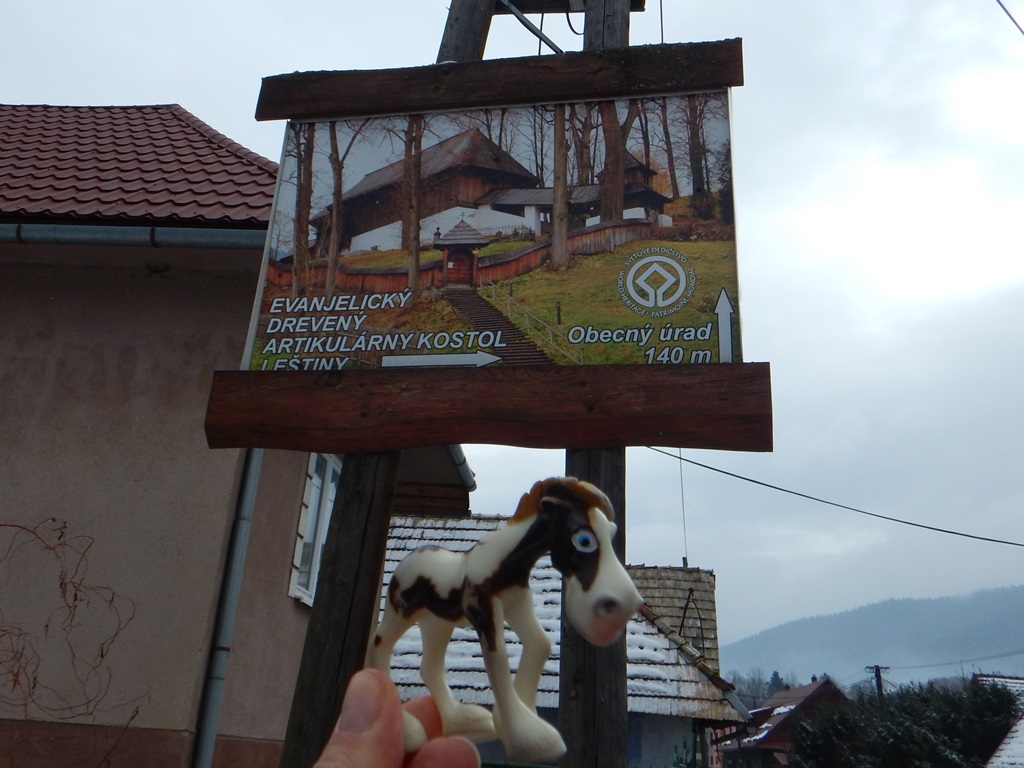
On the right hand side you can see some extensive tourist information. Very useful. If you speak Slovak, of course.
If your Slovak is as poor as mine, I propose we simply go up and see the church.
The church is not too large. It is surrounded by a wooden fence that goes around it.
Luckily, there is a door in the fence.
Behind the door there is a little cemetery.
The outside walls of the church accommodate a little gallery with a small balcony.
From there, you can judge by yourself how small the village is.
Now you probably ask yourself why on Earth someone would build a church on a hill, quite far from the village. And build it out of wood, which is not the most solid type of material. The answer is simple - because he would not have a choice. The church in Leštiny was a protestant church in a deeply catholic Austrian Empire. The emperor has consented in the second half of the seventeenth century that some protestant churches are built in the Kingdom of Hungary (where Slovakia belonged at that time) but imposed several conditions. They had to be outside the city walls and could not be built from stone or steel. A lot like the churches of peace in Silesia. So if you hear again about wooden churches in Slovakia, you will know that they are really wooden. And why.
Unfortunately, this nice sign says that it is strictly forbidden to take pictures inside the church.
I assume the main reason is to protect the paintings on the walls. Because of the limitations related to building materials, paintings were the only way in which the church could have been decorated. To give you a feeling on what the church looks like, we will peep into the Slovak tourist website.
I am sure that those of you who read my blog for a longer time have already some suspicions, since we have seen similar buildings in the past in Poland. And yes, this is a wooden church. A wooden church that is part of a UNESCO World Heritage Site called Wooden Churches of the Slovak part of the Carpathian Mountain Area.
On the right hand side you can see some extensive tourist information. Very useful. If you speak Slovak, of course.
If your Slovak is as poor as mine, I propose we simply go up and see the church.
The church is not too large. It is surrounded by a wooden fence that goes around it.
Luckily, there is a door in the fence.
Behind the door there is a little cemetery.
The outside walls of the church accommodate a little gallery with a small balcony.
From there, you can judge by yourself how small the village is.
Now you probably ask yourself why on Earth someone would build a church on a hill, quite far from the village. And build it out of wood, which is not the most solid type of material. The answer is simple - because he would not have a choice. The church in Leštiny was a protestant church in a deeply catholic Austrian Empire. The emperor has consented in the second half of the seventeenth century that some protestant churches are built in the Kingdom of Hungary (where Slovakia belonged at that time) but imposed several conditions. They had to be outside the city walls and could not be built from stone or steel. A lot like the churches of peace in Silesia. So if you hear again about wooden churches in Slovakia, you will know that they are really wooden. And why.
Unfortunately, this nice sign says that it is strictly forbidden to take pictures inside the church.
I assume the main reason is to protect the paintings on the walls. Because of the limitations related to building materials, paintings were the only way in which the church could have been decorated. To give you a feeling on what the church looks like, we will peep into the Slovak tourist website.
![]() |
| Source: www.slovakia.travel |
Saturday, 13 January 2018
Liptovský Mikuláš
Liptovský Mikuláš is a small town in Northern Slovakia, just next to the Chopok mountain. It has something around thirty thousand inhabitants and is a perfect location for a short stroll on a winter night.
The history of Liptovský Mikuláš dates back a thousand years. In the Middle Ages it was granted several privileges, coming into force through parchments and great seals made of red wax.
Have you noticed something special? Yes, the name of the town is different there. In fact, the original name of the town was until 1952 Liptovský Svätý Mikuláš which means "Saint Nicolas of Liptau", where Liptau is the region in which it is located. So where is the Saint Nicolas? In the church of course.
The gothic church of St. Nicolas is one of the landmarks of the town. Inside you will immediately recognise the high arches on the ceiling.
The small organ is decorated with pictures of the twelve apostles.
The gothic altar is covered with gold and includes tall and pale figures. Am I the only one to see here a whole team of Maries?
Outside the church you will notice a monument. It is the monument of Janko Kráľ, a romantic poet, one of the first ones to write in modern Slovak language. He was also a patriotic activist in times where Slovakia did not exist as a country but was part of the Austro-Hungarian Empire.
Because Liptovský Mikuláš is an important place for the Slovak identity. Just look at this building.
Between 1713 and 1793 it was the capital of the Liptov region and this was the first County House.
But do not think that Liptovský Mikuláš is only living its past. They have public wifi all around the Town Hall.
The Town Hall is located, not surprisingly, on the Market Square.
As you can see, the building is nicely lit up with Christmas lights. So are the streets around it.
The only dark place is directly behind the Town Hall. This is a monument commemorating the soldiers of the Red Army. Soviet heritage is not valued high these days in Eastern Europe.
The snow has invaded the town.
So I propose that we stop here and order a good warm burger.
The history of Liptovský Mikuláš dates back a thousand years. In the Middle Ages it was granted several privileges, coming into force through parchments and great seals made of red wax.
Have you noticed something special? Yes, the name of the town is different there. In fact, the original name of the town was until 1952 Liptovský Svätý Mikuláš which means "Saint Nicolas of Liptau", where Liptau is the region in which it is located. So where is the Saint Nicolas? In the church of course.
The gothic church of St. Nicolas is one of the landmarks of the town. Inside you will immediately recognise the high arches on the ceiling.
The small organ is decorated with pictures of the twelve apostles.
The gothic altar is covered with gold and includes tall and pale figures. Am I the only one to see here a whole team of Maries?
Outside the church you will notice a monument. It is the monument of Janko Kráľ, a romantic poet, one of the first ones to write in modern Slovak language. He was also a patriotic activist in times where Slovakia did not exist as a country but was part of the Austro-Hungarian Empire.
Because Liptovský Mikuláš is an important place for the Slovak identity. Just look at this building.
Between 1713 and 1793 it was the capital of the Liptov region and this was the first County House.
But do not think that Liptovský Mikuláš is only living its past. They have public wifi all around the Town Hall.
The Town Hall is located, not surprisingly, on the Market Square.
As you can see, the building is nicely lit up with Christmas lights. So are the streets around it.
The only dark place is directly behind the Town Hall. This is a monument commemorating the soldiers of the Red Army. Soviet heritage is not valued high these days in Eastern Europe.
The snow has invaded the town.
So I propose that we stop here and order a good warm burger.
Subscribe to:
Comments (Atom)