Saturday, 7 October 2017

Żelazowa Wola

We will visit today the birthplace of one of the most famous Polish composers. Or maybe one of most famous Polish people at all. Welcome to Żelazowa Wola, the house of Fryderyk Chopin.


The house itself is rather modest. In fact, Chopin's father was working as the teacher of the children of its owners and his family was living here with him.


Today, the house has been turned into a museum. Let's walk inside.


 You can find there artefacts from Chopin's life. Like his diary.


Or his desk.


And of course, his piano.


But I must admit, that I was nonetheless a bit disappointed with it - some of the rooms are quite empty.


If you fancy museums and you want to discover more about Chopin, his life and his music, you can go to this modern building behind the roses.


But I would rather suggest that we move to the nice park that surrounds Chopin's house. You can see here small rivers, with lovely little bridges ...


... ponds ...


 ... and enchanted pavilions.


 The music is omnipresent. It can even come as a surprise on the wall!


Obviously yet another monument of Chopin does not come as surprise at all. 


Look, there is a secret door over there. 


Where are all these people going? Let's follow the to find out.


It seems that we are back to Chopin's house, or more precisely the backyard. All those people are waiting for a concert! On Sundays renown pianists are allowed to play on Chopin's piano (the one we have just seen!) in his house.


And through the open window, the music enchants the place. 

Saturday, 30 September 2017

Durmitor National Park

We have spent the last few weeks on the Montenegrin Riviera. But today we will say goodbye to sandy beaches and emerald sea.


We will be heading to one of the National Parks of Montenegro. To reach it, we need to pass through mountains. Since Monte-Negro means literally "Black Mountain", I would expect them to be black. But to my surprise, they were green.


Then we need to drive on the shore of Lake Skadar. They say that if you are lucky, you can meet there pelicans.


The Skadar Lake is alimented by river Morača. The river is narrow and shallow.


But what makes it interesting is that it runs in a canyon, which means that it is surrounded on both sides by high hills. And when I say high, I mean it.


In fact, the road is winding together with the river, glued to the steep slope. You will not be surprised to hear that it is considered to be a very dangerous road.


Finally, we reach our destination. The Durmitor National Park.


Its biggest attraction is the canyon of river Tara, the deepest in Europe and second deepest in the world. Just imagine, that this small, shy river has shaped such big mountains.


As we stop to take a break, we can show our admiration to the best alpinist of the region, Dušan Bulatović Džambas.


Time to move again, the biggest attraction is still ahead of us.


I am sure that you are curious to know what this biggest attraction is. Well, it is a bridge.


Does not sound impressive? And if I say this used to be the tallest bridge in Europe? Đurđevića Tara Bridge links to sides of the canyon of the Tara river and is for sure an amazing piece of civil engineering.


No matter if you look on the left ...


... or on the right, it is almost hard to notice the river itself. I even start to wonder if it was really needed to build an entire bridge over it.


It is by looking down from the bridge that one realises that it is maybe not that small. And that building a lower bridge was not real an option. At least until humans invent lorries that can go up the hill. Horizontally.


Obviously, humans have invented a smarter way to move over Tara river. They call it a zip line. No one will ever convince me that human beings are fully sane. No horse would ever try to ride on a thin line over a canyon.


I hope that now you understand why Durmitor National Park has joined the UNESCO World Heritage List. It is indeed one of a kind.


Saturday, 23 September 2017

Fortress of St John in Kotor

If you thought that we are fully done with Kotor and its bay then I have a surprise for you. Here comes the third time lucky post from the region. And we have a very good reason for devoting a separate post to the Fortress of Saint John in Kotor, since it is part of yet another UNESCO World Heritage Site, inscribed on the list in 2017 only - the Venetian Works of Defence


As you have seen in the last post, the Kotor fortress is located high up the mountain. So say goodbye to the sea level ...


 ... and prepare to climb up 1,350 steps!


As we conquer the steps, the magnificent panorama opens to us. You can admire both the city of Kotor, with its many churches ...


... and the entry to the Kotor Bay. Unfortunately some trees still hinder the full picture.


Somewhere in the middle of our way to the upper fortress you will find the church of Our Lady of Health, where the troops could attend their Sunday service.


It is only from the upper side of the walls that we can fully acknowledge the amazing construction of the city walls of Kotor, with the very unique triangular harbour.


And it is also only from the top of the hill that we can truely appreciate the entrance to the Kotor Bay. No trees this time.


And here it comes, the Fortress of Saint John which once upon the time protected the sea routes and ports of Venice in the Adriatic Sea.


Today Venice is just a small town in Italy. So the lion of Saint Marc does not roar anymore in Kotor. The Montenegrin eagle spreads his wings wide on top of the fortress.

Source: https://meanderbug.com/

Saturday, 16 September 2017

Kotor city

In the last post we discovered the amazing Bay of Kotor. Those of you who have looked at the link to the UNESCO website recognised, that the site covers the whole region, including the city of Kotor. So it is time to discover the place that gave the bay its name. Let's leave our boat in the marina and move along.


The Old Town of Kotor is guarded by a solid wall.


The location of Kotor is very safe, with the sea in front and a mountain behind. Very feng shui.


Though to be honest, the pragmatic architects of Kotor made sure that the wall climbs up the hill as well.


I propose that we enter by one of the gates on the right. There are two reasons why I chose it. First it has a very cute guardian with long red hair.


And second, amoung the flags you can quickly spot the UNESCO emblem.


As we pass the moat, you can notice the barred window that allowed defenders to take a close look at whoever would like to approach the town from the sea.


If you want to find out more about the maritime heritage of Kotor, I strongly encourage you to visit the Maritime Museum.


Kotor was a Venetian city and then it belonged to the Empire of Austria and Hungary. As we walk through it, you can feel a certain mixture of styles. The palace of the Prima family was build in the seventeenth century and looks quite Italian.


The Town Hall which used to be the Austrohungarian general staff house was built in the nineteenth century.


Next to the Town Hall you will notice the cathedral of Kotor, devoted to Saint Tryphon (do not worry, I have never heard of him before either). It was built in the twelfth century, when Byzantium was still powerful.


Inside, the cathedral is pretty modest.


Look up to those little windows. They bring light but they do not go to the external world, they link the church to an internal gallery that runs on the upper floor and which houses the museum of the cathedral.


You can admire there some religious artefacts as well as paintings.


To reach the gallery you need to use the staircase, made entirely from Italian marble.


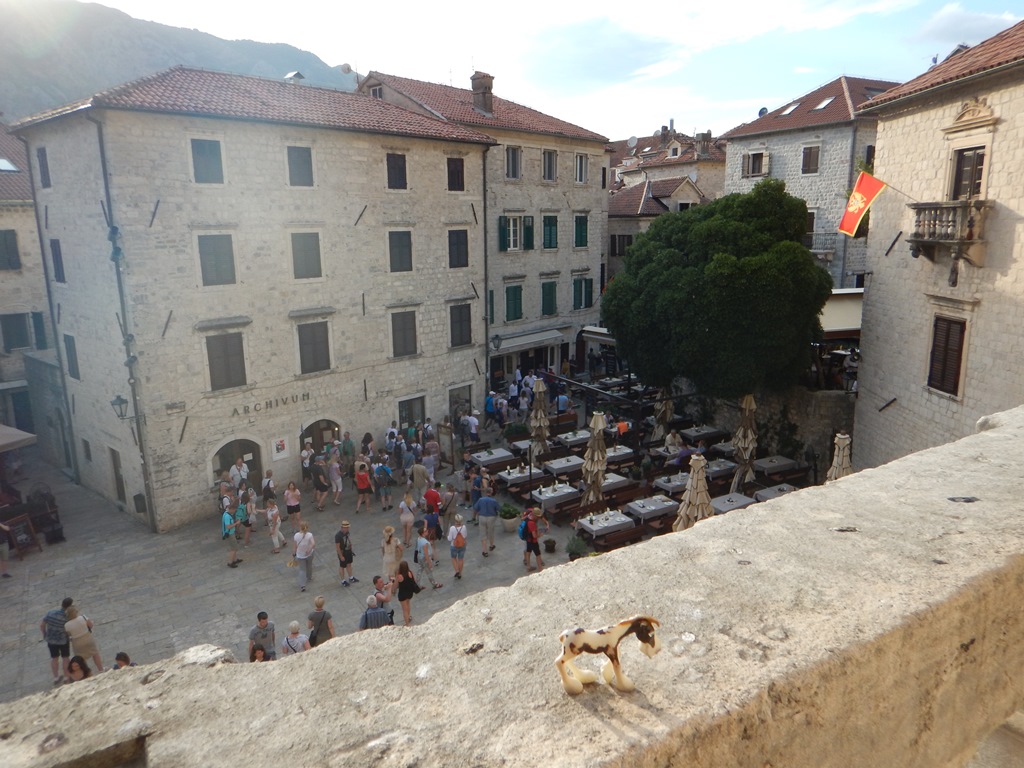
On the picture showing the facade of the cathedral you might have noticed that between the towers there is a balcony. It looks a lot like the one in the cathedral of Saint Marc in Venice which we have visited last year. And like with the other, you can admire there the market square from bird eye perspective.


As you may have guessed, the cathedral is not the only church in town. Because of the mixed cultural background of the inhabitants, there has to be also an orthodox church. Or better two. The large Saint Nicolas church ...


... and just next to it a smaller one, dedicated to Saint Luke.


The streets of Kotor are narrow and shadowy so it is not easy to take good pictures. So I strongly encourage you to take a look at one of the many panoramic pictures available on a special website. Alternatively, we may also try to look at the city from the top by climbing up to the Fortress of Saint John. Ready? Then take a short break and we will climb up next week.