Saturday, 3 October 2015

Modlin Fortress

The Modlin Fortress is one of the biggest and best preserved in Poland. It was built based on an order of Napoleon Bonaparte at the times of the Duchy of Warsaw, a satellite state occupying lands conquered by Napoleon after he has defeated Prussia at the beginning of the nineteenth century.


Since many of you have told me that you have liked the city game we have had in Olsztyn last summer, this time again we will organise our visit around a quest for clues. We will try to find all figurines of Baśka Murmańska. And no, it is not a lady serving in the army. You will see her in a moment.

Let's start next to the Information Center.


Our first clue is almost self-explanatory.


And yes, Baśka (a diminutive for Barbara) was a bear. A white, polar bear. One of the soldiers found her in Northern Russia and took her with him. She was then living in the fortress as a kind of mascott.


Next to the Information Center we will find the casino. At that time, it was a kind of club for officers, where they were eating and partying.


Next to it you will find a monument dedicated to Polish soldiers who have left their lives defending the Modlin fortress in 1939.


Obviously after 200 years some of the buildings are no longer in use.


But others are still in (military) service.


This one is particularly important. Being 2,200 m long, the fortified barracks building is the longest building in Europe.


Nowadays, a large part of the Modlin fortress was sold to private investors. This has some positive sides, since they have refurbished the historical buildings so that they can serve some new purposes.


This one is a 4-star hotel.


The lions guarding the main entrance are not the only animals in this part of the fortress. You will find here beehives ...


... and yes, another little statue of Baśka!


The Modlin fortress is full of contrasts. Concrete bunkers ...


... are neighbouring a wooden chapel.


And next to the chapel there is another small bear waiting for us. Once we find it, we can move to the last point of our game. A pastry shop!


Let's give a five to the last figurine of Baśka. The story of her life was unfortunately not ending with a piece of cake. She has escaped from the Modlin fortress and before the soldiers found her she was killed by villagers from neighbouring village, looking for food and a warm fur.


Now that we have walked all around the Modlin fortress (and refreshed ourselves with some food ice-cream), I propose we take another small walk towards the external wall of the fortress.


The reason why the Modlin fortress was created in this specific place will soon become obvious to you. Those of you who know a bit about military strategy probably guessed now that the Modlin fortress is located next to a river. Obviously you are right.


But the truth is that the fortress is located in a place where two major Polish rivers connect - Vistula and Bug.


On the islet that is just between them Napoleon has built a granary. He believed it was the safest place to keep wheat for the fortress so to prevent it to be taken by hunger.


The fact is that enemy armies have not proved to be as disastrous as time. Nowadays the granary is a ruin and a distant memory of the past glory of the Modlin fortress.


Saturday, 26 September 2015

Rhine Falls


Switzerland is all about water and mountains. And watches. And chocolate. And cheese. Alright, there are many great things in Switzerland but the truth is that nature is spectacular here. One of the most amazing nature shows are the Rhine Falls.


They are located close to Schaffhausen (famous for watches of course), on the High Rhine. They are the biggest falls in Europe in terms of water flow. 


I would suggest that we start our visit from the side of Neuhausen am Rheinfall. This little castle houses a nice restaurant, a souvenir shop and a pier for boats that will take us on a little tour close to the falls.


There is plenty of fish here as you see. This is because they are unable to swim up the falls and need to stay below.


Finally we are on the boat. The water is quite shaky so do not stand up from your seats.


The driver's job must be deprived of all excitement, the total length of the cruise is probably a few hundred meters. Though I am not sure if one can get ever bored with the view.


One amazing thing about the Rhine Falls is that little rock in the middle, called Rheinfallfelsen. It is possible to climb it up but be careful, the path is steep.


The view is worth the effort though.


Do you feel the water drops on your face? Great feeling, isn’t it?


Those rocks do not look inviting so be careful not to slip.


The castle on the other side of the lake is called Laufen Castle. It used of course to belong to the noble family of Barons of Laufen but today it is a youth hostel.


Would you like to visit the castle? Great, this is just a half an hour walk. We will cross Rhine through the aqueduct-like bridge and we will be able to see the falls from close again.


Actually, there is a similar one on the other side, just that it does not have water below but trains on.


You might though that such big falls generate lots of hydropower. Well, they do, but just for their own pleasure not for the humans. Many energy companies tried to build a hydro power plant here but the Swiss people opposed to it heavily and on more than one occasion. So all you can see is an old fashion mill.


One of the reasons for this protective approach to Rhinefalls was to preserve its touristic features. Another one was to protect the wildlife. If you watch carefully, you can spot many birds.


What has amazed me most here is the contrast between the fierce power of the falls and the peaceful stability of Rhine just above them.


And the colour of the water is amazing too.


At night, the Rhine Falls are illuminated by these huge lamps.


The results can be spectatular. This one comes from a special celebration for St. Patrick day.

http://www.thejournal.ie/going-green-landmarks-across-the-world-honour-ireland-1367105-Mar2014/#slide-slideshow12

Here you can see the rock again. And yes, we were on top of it!


Finally we arrive to the bridge.


Look, there is a train coming out of the hill. It seems that there is a train station just below the castle.


Let’s get inside the castle now.


As I mentioned, the castle itself is now a hostel.


The walls have little wholes. Most probably in the past they were used as shooting positions. Though honestly speaking, I do not know to whom they could shoot from this part of the river.


And here comes the full view from the castle.


I hope that you have enjoyed this trip. For those who look for more contact with the Swiss nature, I recommend taking a canoe and going down the Rhine to Lake Constance.


I have heard it is a very nice place. If you can confirm it – let me know and maybe in some time I would put it on my travel list as well.


Saturday, 19 September 2015

Polish Museum in Rapperswil

As you might have noticed, the human family in which I live is Polish. Polish people are amazing - you can get them out of Poland but you cannot get Poland out of them. As a result, when we came to swim a bit in the Zurich Lake, the first thing that they wanted to visit was the Polish Museum in Rapperswil.


The Museum is located in the Rapperswil castle.


It was created in 1870 when the Poland did not exist - it was invaded and divided between its neighbours, Russia, Prussia and Austria. Władysław Plater has then leased the Rapperswil castle to create there a safe place for some of the cultural treasures being part of the Polish national heritage. It was also a refuge for Polish patriots, both soldiers and civilians, fighting for its freedom. Many famous Polish people have spent some time living and working here, for example the famous writer Stefan Żeromski.


Let's enter inside the castle.


In the courtyard you will find a nice restaurant.


The museum is located on the second floor. Next to the entrance you can see the coats of arms of former Polish regions (voivodships).


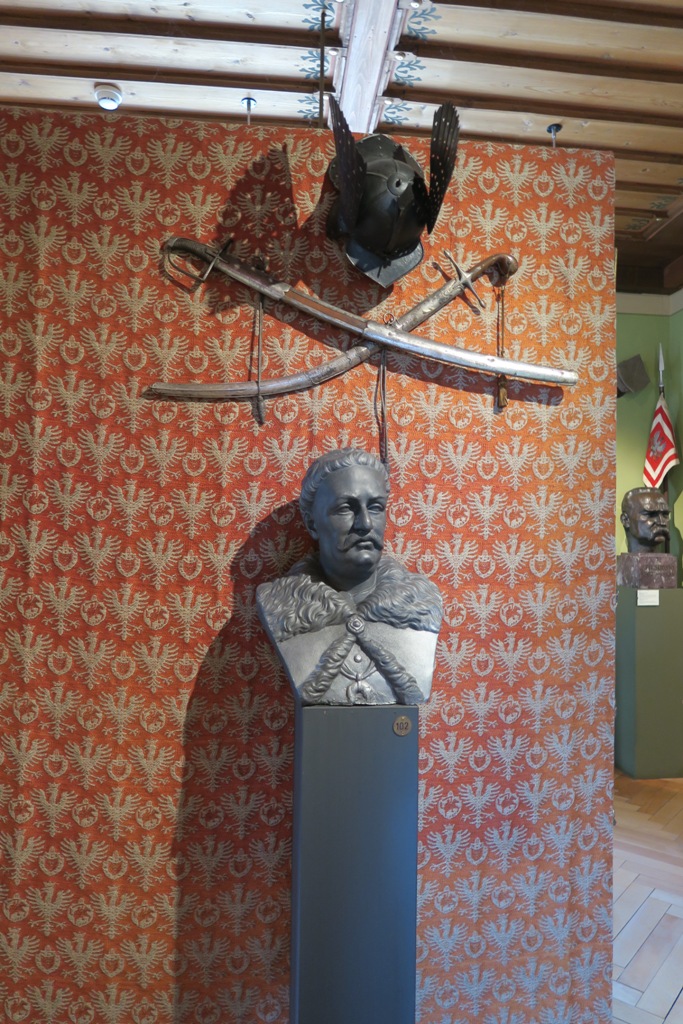
Most of the books and other historical artefacts were moved back to Poland in 1927. Unfortunately, in1944 they were burnt by German nazis together with other valuable items from Polish national heritage. Today, you just see a few items, like sabres from the times of king John III Sobieski.


 You can also have a look at a few really old books, dating back to sixteenth century.


Since Rapperswil was the beating heart of Poland in days when Polish patriots were not safe in their homeland, you can see here numerous exhibitions devoted to Poles that had to flee their country in different periods. In 1830, after the November Uprising ...


... in 1940 during World War II ...


... and in 1945, when the communists took over Poland.


Recently, Poland has celebrated 25 years of (full and effective) freedom. As a result, the Rapperswil museum is slowly getting populated also with exhibitions of modern Polish art.


Before we leave the museum, I propose that we go up to the tower. It may look tough, but trust me, it is worth it.


From the top of the tower we can see a fantastic panorama of the town ...


... and the Alps in the background.


We horses live from one day to another. I am always impressed by the human ability to keep and celebrate memories. I truely recommend you to pay a visit to the Rapperswil museum. Even if you do not live with a bunch of Polish people.