Saturday, 23 June 2018

Old Town of Stockholm

I will take you today on a visit to the capital of Sweden - Stockholm. We will start at the City Hall. The City Hall was designed by the architect Ragnar Östberg and is built from eight million bricks. On top of the spire you can notice three crowns which you will also find in the coat of arms o Sweden.


The great Nobel banquet is held at City Hall. After dinner in Blå Hallen, the Blue Hall, Nobel Prize laureates, royalty and guests dance in Gyllene Salen, the Golden Hall, with its 18 million gold mosaic tiles.


The City Hall is located on the seaside, let's walk through those arcades to see more.


Between the columns of the arcades a cool shadow reigns.


But on the other side the sun is shining bright.


The red bricks of the City Hall become even more red now.


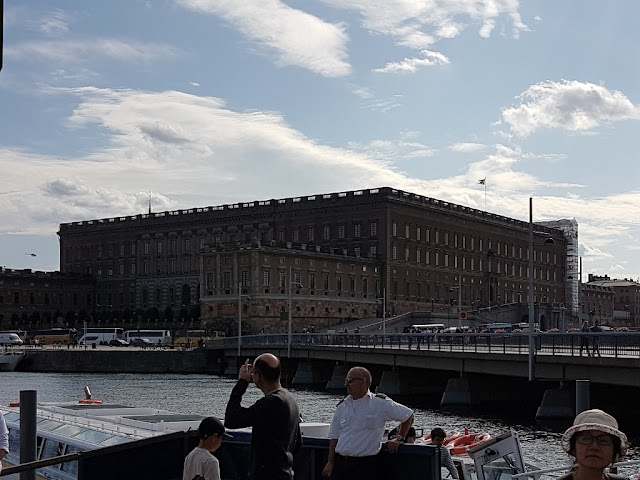
On the other side of the bay you can see the Old Town and the Royal Palace.


I propose that we see it closer. The streets of the medieval Old Town of Stockholm are narrow and colorful.


The Royal Palace is the official residence of His Majesty the King of Sweden. With over 600 rooms it is one of the largest palaces in Europe! The Palace was largely built during the eighteenth century in the Italian Baroque style, on the spot where the “Tre Kronor” castle burned down in 1697.

In front of the main entry you will always find the royal guards.


 The external walls are quite impressive, decorated with sculptures.


So is actually the interior of the palace.


Next to the Palace stands the Saint Nicolas church, belonging to the Lutheran church of Sweden.


But the most important thing in the neighbourhood of the Royal Palace in Stockholm is of course the statue of the horse of the Crown Prince Karl XIV Johan. And his master by the way.


Since the day is warm and sunny, I propose that instead of visiting all the dark museums the city has to offer, we discover Stockholm in a different way. Stay tuned for the next post on our blog

Saturday, 16 June 2018

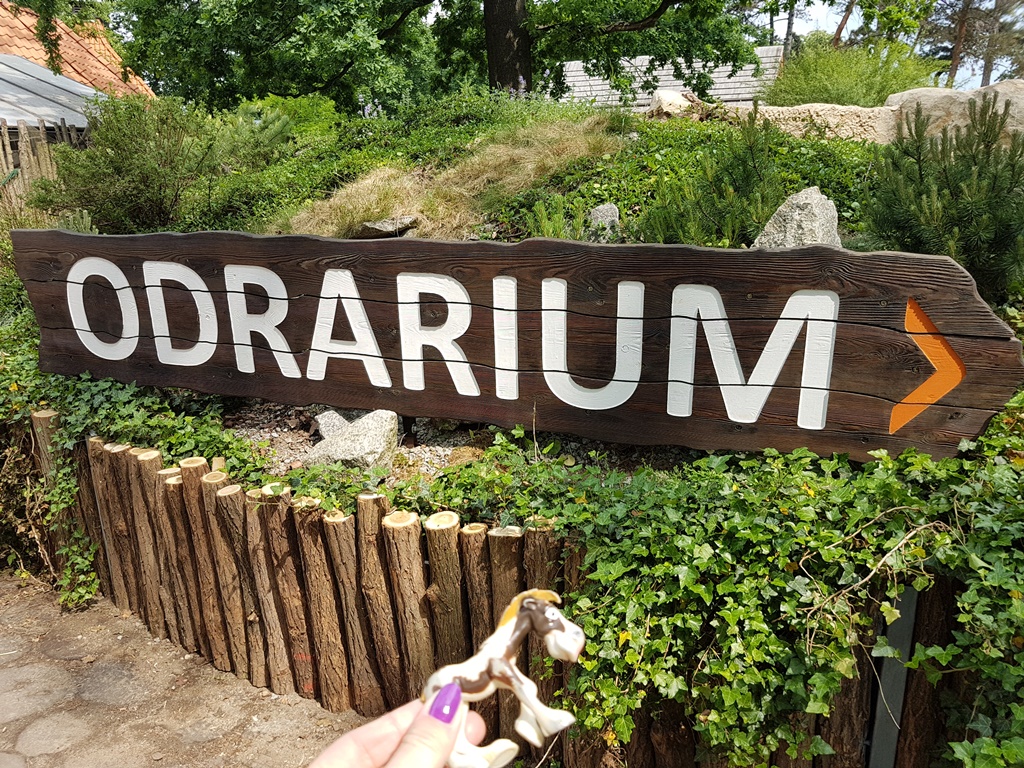
Odrarium

The Wrocław's zoo has a few special exhibitions that focus on a specific region or a specific type of animals. Let me take you today to one of them. It is a bit special because zoos usually focus on exotic animals coming from remote places where most people living in that city would never go. But the zoo in Wrocław has a special exhibition devoted to the river Oder that runs through the city. It is called Odrarium.


All starts with a pump room.


The water runs of course on a smaller scale.


Oder is not a particularly clean river, at least judging by this tank.


The fishes do not seem unhappy though.


I was actually surprised by how many different species can be found in Oder. There are salmons and touts. There is even one called piglet.


Each water container is accompanied by a complete list of its inhabitants.


I wonder where does all this air bubbles come from. Do you think that the fish actually sing?


Odrarium is maybe not overwhelmingly impressive but it is really interesting to get to know the fauna and flora of one of the most important rivers in Poland.


These round-shaped windows make me think of the Shire, green and peaceful. Let us stay here for a moment to imbibe this tranquillity.


Saturday, 9 June 2018

Zoo in Wrocław

It is hard to believe that it has already been three years since we have visited Wrocław. Today I will take you into the famous Wrocław's zoo that is located just on the other side of the street facing the Centennial Hall.


In the open air you can find animals coming from all continents. The brown bears live in Europe, Asia and North America. They are a protected species, with two hundred thousand teddies left.


African rhinoceros is not only protected. It is also endangered because humans hunt it for its horn.As if they could not mind their own noses.


Another inhabitant of Africa, though probably less known, is Okapi. Looks like a child of love between a giraffe and a zebra.


Asian elephants eat up to 120 kilograms of food per day. They were of course busy eating when  arrived.


Luckily they took a short break to greet us.


Though obviously giraffes are of course present as well.


As you know giraffes love to eat leaves from top branches of the trees. Since in a zoo they cannot move around from tree to another and it is not possible to plant new trees next to them all the time, the zookeepers found a workaround by tying large branches to the fence.


South America is represented by nandu, not to be confused with an ostrich. Have you noticed that there are two of them on the picture?


Nandu's feathers melt with the trunks of the trees. Just like camels are becoming invisible in a large sandy desert.


Actually they are pretty much of the same colour as the king of the animals. But lions do not melt that easily into the grass. Even if they seem to be melting indeed.


I mentioned more than once that the very idea of zoos does not appeal to me too much. Each time I wonder how would humans feel if the roles were reversed. This feeling is particularly strong when I see in a zoo monkeys and apes. Maybe the baboons do not look too familiar (though I have met a few humans who seemed surprisingly close to them).


But a chimpanzee looks very human.


Just look at the food next to the cages of the chimpanzees. If I would tell you that the picture comes from a fancy vegan restaurant, I am sure you woule believe me.


Because we are all a big family - humans and animals alike. We need to respect each other and remember that we share more than what divides us.


Saturday, 2 June 2018

Toruń's gingerbreads

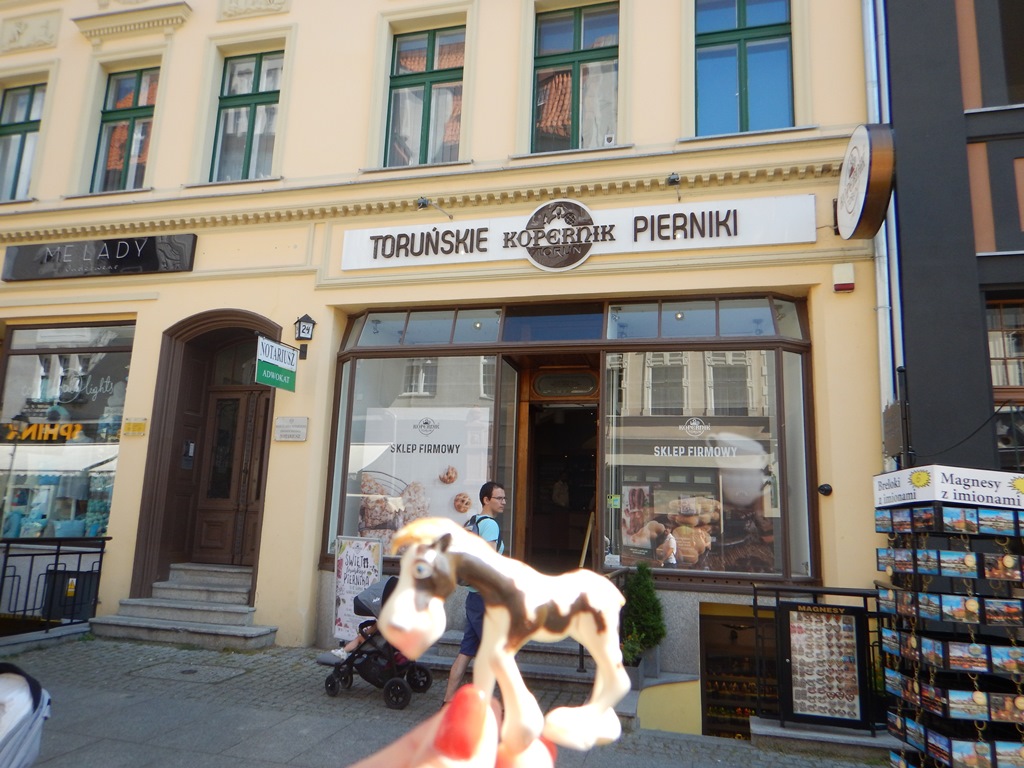
If you would ask a Polish person what Toruń is famous for, without any doubt they would first mention Kopernik. And in a second place they would most probably list pierniki or gingerbreads. You can see shops with gingerbreads everywhere. On your left ...


... on your right ...


... and in the middle. The most famous gingerbread maker is actually called Kopernik.


If you want to discover more about Toruń's gingerbreads, I would invite you to walk with me inside the Museum of Gingerbreads.


The first known recipe for Toruń's gingerbreads comes from eighteenth century. To make them, you need a pot, honey, water and a good measure of strong spirit. Then come the spices - ginger, cloves, cinnamon, nutmeg, pepper, cardamom, anise and lemon peel. And of course sugar. Finally comes the rye flour.


When you have the dough, all you need is a form. These can be simple ones. Those two shapes are actually the most popular ones.


The ones which look like six bubbles are called "katherines".


But the most famous gingerbreads have fantastic shapes. They can look like animals ...


... or like human beings.


It is almost impossible to stop oneself from trying to bite them. Actually it seems someone did lost that fight. But it was not me!


To make such amazing moulds you need a woodcarver. Or you can try yourself at home. The process of making a mould is three-step. First you need to choose the right piece of wood, usually an apple tree or a pear tree, without knots. Then you need to use tracing paper for an outline. Finally, you need to remove the wood to form the mould.  Sounds easier than it is in reality. Woodcarvers are sought-for artisans with larger workshops.


Finally, we need to bake our gingerbreads in a large oven.


The last piece of the journey of a gingerbread is a gingerbread shop. In the nineteenth century it could have looked like that.


In the 1970s probably more like that.


Alternatively, you could buy them from a gingerbread-lady, walking down the streets of the Old Town.


I hope that now you know how to convert this ...


... into that.


Enjoy!