Saturday, 17 December 2016

Augustusburg Hunting Lodge

My human family told me that they plan to visit the Augustusburg castle. I said "Great, it is one of the most beautiful UNESCO World Heritage Sites in Germany". Too late did I discover that they actually meant the Augustusburg Hunting Lodge in Saxony while I meant the Augustusburg Castle in North Rhine-Westphalia. But small disappointments can sometimes turn into nice surprises. Let me then take you to the first Augustusburg castle on our trail. I do trust that we will see the other one some day as well.

The castle is located on a hill that is 516 meters high, on top of the town called (yes, you surely guessed) Augustusburg. It is surrounded by a park, in which you can find the "Fairytale Fountain" (Märchenbrunnen).


Let's take this path and go up the hill. Be careful, the fallen leaves are slippery.


The castle is surrounded by a long wall. It is white, with details in a colour that my human secretary calls "coral" and I will simply call orange.


As we approach from the North, first we need to pass the house of the guards.


Then comes the main entrance to the castle.


The inner courtyard is surprisingly vast.


Since Saxony is no longer ruled by a Prince-Elector, the castle is nowadays a museum. Let's go inside.


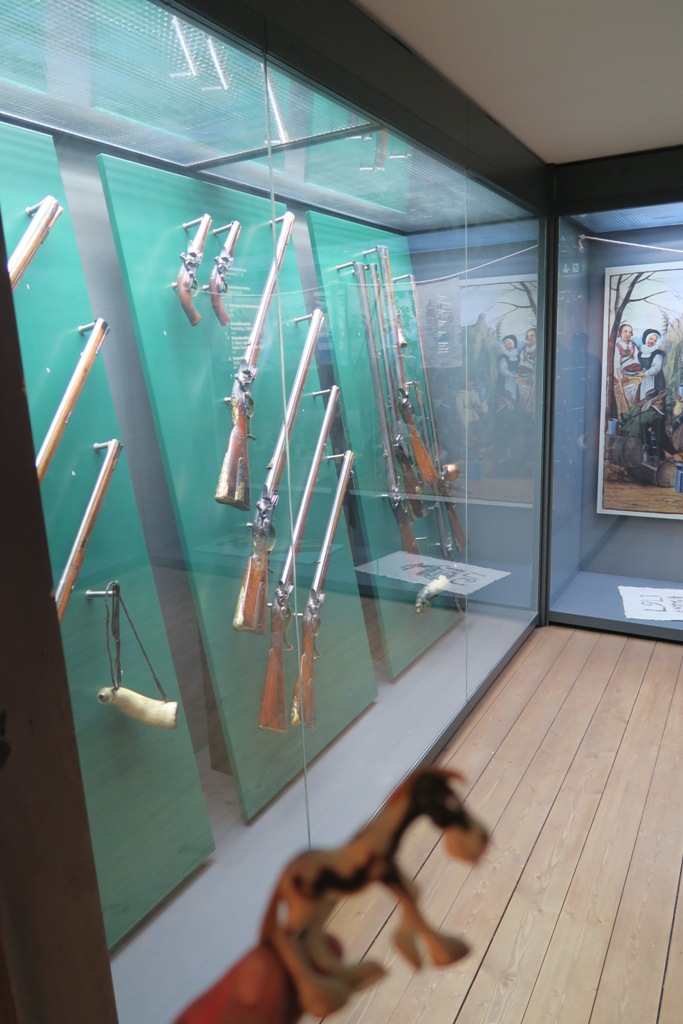
The Augustusburg castle was designed mainly to be a summer retreat and a hunting lodge. Once you enter inside, you cannot be mistaken about its original role. There are traces of both hunting ...


... and summertime leisure.


I can only hope that after having one of these mugs that could hold probably two litres of beer nobody tried to actually use the hunting equipment.

Through the window you can see the backyard. We will go there as well in a moment.


On the right you can see the Zschopau valley that lies beneath the Schellenberg hill.


Let's go out again and check on the backyard. We need to take the South gate.


In the old castle’s farm buildings we will find the Stage Coach Museum. Some of the carriages exhibited there are simply amazing. This one has the coat of arm's of Saxony.
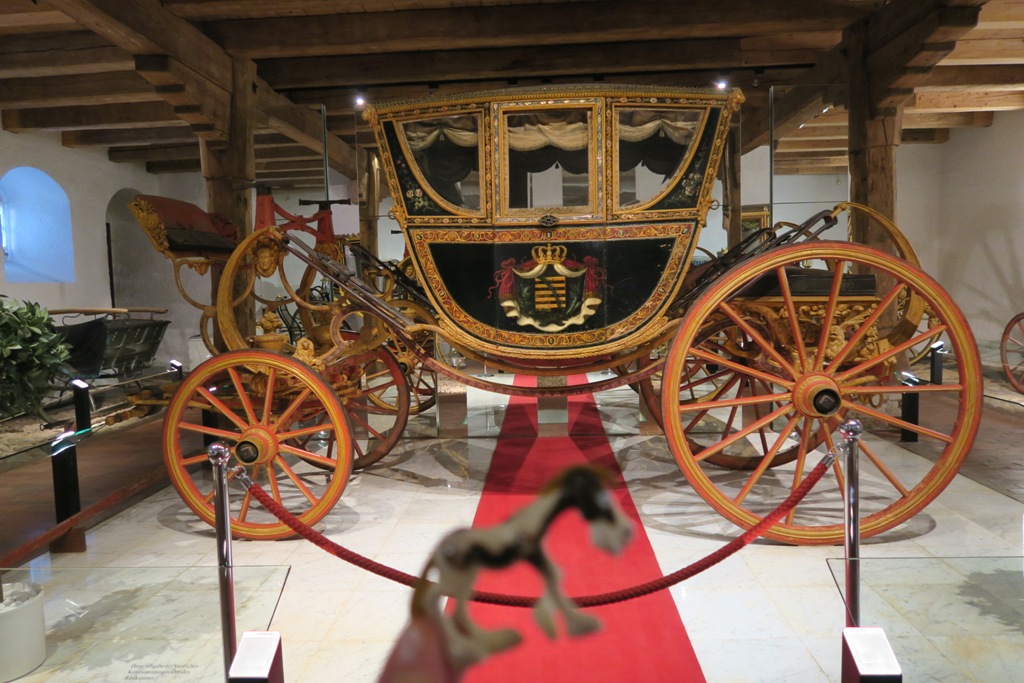

This one is called a berlin and was probably at some point in time covered with golden ornaments.


The museum has also some less exclusive exhibits.


There is even a cabrio!


But I liked best this winter edition. Horse-drawn sledges must have been real fun. Though not for the horses of course.


I hope that you agree with me that travelling always brings some fun, even if it is another type of fun that one would expect. The Saxon Augustusburg Castle proved to be a nice piece of architecture.


Look, it is getting late! The sundials are maybe not as accurate as modern clocks but without any doubt they indicate that it is time to move on to new adventures.


Saturday, 10 December 2016

Aalen (Limes Germanicus)

At the times when the Roman Empire was still strong and growing, its emperor Augustus decided to build a line of frontier fortifications that would protect Rome from the German tribes. His successors kept on adding new forts and  watchtowers. At the end, the fortification line was 568 km long and run through a large part of Europe.


Another line runs in Africa and the Middle East. The reason for this is simple - the Roman Empire was one of the largest states in history (the largest was the British Empire, which before World War II covered over 20% of Earth's surface and population).


This frontier fortifications line, often referred to by its Latin name limes, is classified as a UNESCO World Heritage Site.


Today I invite you to take a closer look at what remains from this fantastic idea. We will visit the limes museum in the German town of Aalen.


Aalen was the largest Roman cavalry fort North of the Alps and was built around 160 AD.


Inside the museum you can see some reconstructions that may guide your imagination to this period. Next to a model of a fort with a palisade ...


... you can see what remains of such palisades, built two thousand years ago.


You can see the faces of some of the Roman emperors.


This one was called Caracalla and has a reputation of being one of the nastiest amoungst his peers. Well, he does look like one.


Since the Aalen fort was used by the cavalry, obviously my ancestors are omnipresent. You can see them on sculptures ...


... on reconstructions ...


... and there are even some of the remainings of the previous inhabitants of the place.


I propose that we leave the museum building and go outside. First, we can see a reconstruction of the rooms in which the soldiers spent most of their time relaxing ...


... and working. And yes, in time of peace they were mainly a kind of customs office.


Obviously these are only recent reconstructions, since after two thousand years all that is left from the original Roman fort are the foundations.


The building itself must have been quite large.


Even after all these centuries, the rocks hold on remarkably well.


An information signs in Roman time was much more solid than nowadays. But imagine to make a spelling mistake in the first line and only discover it once you have finished it, three weeks later ...


The gentleman here was one of the leaders of the troops. I can understand than in Italy they were wearing this type of clothes. But I wonder how they were surviving the cold winters of Baden-Württemberg without long johns.


If you are wondering how the Romans were building their forts in time when cranes and bulldozers did not exist you can look here - this is a reconstruction of a typical building machine from Roman times.


I hope that you have liked this little glimpse into the history. Life in the Aallen fort must have been tough. But its inhabitants have really known what it means "living on the edge".


Saturday, 3 December 2016

Monte San Giorgio

Monte San Giorgio is a mountain close to the city of Lugano in the Italian-speaking canton of Ticino, in Switzerland. It is not high, does not have an unusual shape, still, it has a tremendous importance for the history of the Earth. Tremendous enough to be recognised as a UNESCO World Heritage Site.


So let's jump on the PostAuto, the famous yellow busses of Switzerland.


The uniqueness of Monte San Giorgio relates to its geological structure that shelters amazing paleontological artefacts. In most places in the world scientists can find one layer of fossils, coming from a distinct period. Monte San Giorgio is composed of seven layers of fossils, coming from consecutive eras, which allows the scientists to study the evolution of species living in this region over millions of years.


In the Middle Triassic geological period, Monte San Giorgio lied on the shores of the huge Thetys Ocean which separated Africa from Eurasia. In the shallow waters many species have quickly evolved.


When the dead animals were sinking they had the best possible conditions for fossilization.


One of the things that I liked best in the Monte San Giorgio museum was that the fossils are paired with models which allows the imagination to work better.


Besides fish-like animals, Monte San Giorgio was also home to shell-like ammonites.


You can also admire there different types of sediment rocks.


Look, they were even smart enough to create the Swiss flag out of Monte San Giorgio rocks.


I must say that I was impressed by the diversity of the marine fauna that has lived around Monte San Giorgio.


Maybe you would like to check on by yourselves if any of them are still around? It seems that we will need to watch out for their descendants at least.