Saturday, 8 September 2018

Aquapark

Any sunny vacation in a nice and hot place would not be complete without a visit to an aquapark.


Safety first! So please check if you meet the height criteria. You need to be at least 130 centimeters high to be allowed to take all the slides.


Here comes the plan of the slides.


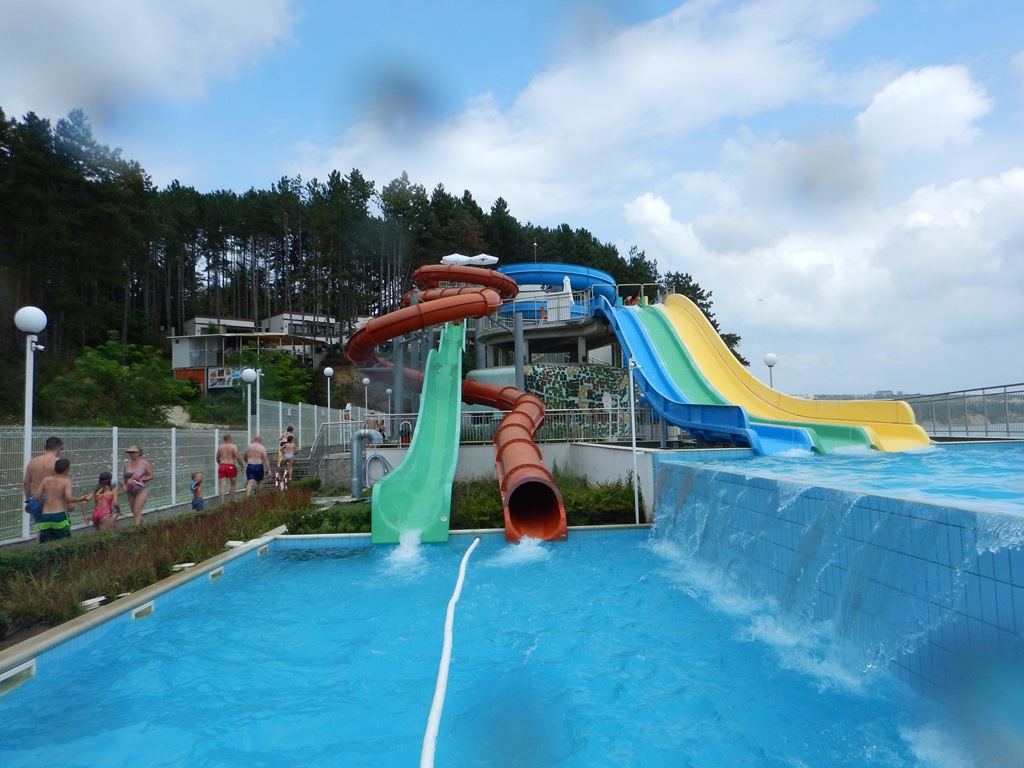
Why don't we start with this triple multicolor slide?


We take the blue one and you can take the green. When you look down you can quickly realise that it is not really steep.


As we get closer to the pool the slide gets flattish.


And hop in the pool!


When you turn back, you will see that the green and the red slides are much higher.

If you take the green one, you will go really fast.


If you take the red one, it will be fast and on top it will be dark. I hope that you will excuse me if I do not join you on that one.


So maybe we will try the blue one? It turns several times but the turns seem mild.


Ready? Then let's have it moving!


That was quite a ride!


All those of you who require some rest now can spend the rest of the afternoon in this fancy pirate ship. Or on one of the sunbeds next to it.


Saturday, 1 September 2018

Obzor

I have received lots of e-mails telling me that such an extensive program in a such a nice country on such a warm summer is unhuman. Or unequine. So I propose we take a short break in the nice small town of Obzor, half way between Nessebar and our next attraction, and enjoy the Black Sea at its best.

In late Antiquity, the West coast of the Black Sea belonged to the Eastern half of the Roman Empire, better known as Byzantium. Obzor was one of many coastal fortifications, located mainly in bays convenient for landing. The little town included various trades as well as a small industry. In 2011, a kiln for construction ceramics was discovered. The remaining part was not too well preserved, as the picture testifies.


But the smart Bulgarian archaeologists managed to reconstruct the kiln.


They say that it was used to make roof tiles and bricks. The production was possible thanks to the abundance of clay, fresh water and presumably manpower.


In the contemporaneous Obzor we can still find some of the old ceramics, not only those used by the construction industry.


Otherwise, this is a nice, sleepy town. Close to the main square you will find a clock tower.


Then comes a war monument.


We cannot miss the church of Saint John the Baptist. A Greek Orthodox Church of course. The interesting thing is that in Bulgarian he is called Ioan Predtech so literally speaking - John the Predecessor, so the one who came immediately before Jesus Christ.


The church is rather small. A service is being held there now so we will not be peeping inside.


Next to the church you can find two interesting constructions. One, pretty common, is a fountain.


The other one, much more unusual and much more interesting, is a public book shelf. Bring one - take one. And enjoy new read regularly. There seems to be books inside so people of Obzor must be honest and trustworthy!


Now that we have paid our respects to the past and the present of Obzor, I propose that we focus on the 3S. The ancient Romans knew that the place is fantastic because of the Sand and Sun.


While you are there, you can work a bit on the towers of this castle.


Or you can befriend the Sea.


You tell me that Bulgaria lies on the shores of the Black Sea, not on Cote d'Azur? Well, it is all a matter of right time, place and perspective. Good night my friends.


Saturday, 25 August 2018

Varna

From Aladzha we will drive only a few kilometres to the main city of the region - Varna. The history of human settlements in this region dates back to Antiquity. The city has been destroyed, burned, conquered and rebuilt several times, belonging in different periods to Romans, Bulgars and Turks. Actually more than once to each of them. Today, it is a nice coastal town, best know for its beach resorts called Golden Sands.


If you want to spend some time in the city rather than on the sand, you are likely to choose one of the city parks that offer the blessing of shadow.


You can sit on a bench.


Or take one of those pedalos if you wish to be close to water.


The small pond is supplied with water by a small river that runs into the sea.


You can also use this opportunity to learn more about Bulgaria and its sacred places and famous people.


Under each marble plate lies the soil from sacred Bulgarian places. Like here - the soil from the Dryanovo Monastery.


Down the lane, you can meet and greet some of the national heroes of different backgrounds. Vasil Levski was a revolutionist who was one of the fathers of the movement that led to the freedom of Bulgaria from the Ottoman Empire.


On the other hand, Simeon was a bishop of the Orthodox church taking care of the Varna and Preslav metropoly.


On a warm summer day, the city of Varna is of course very hot. I would still invite you to take a few steps out of the park and see some of the main landmarks.


You will undeniably find some churches ...


... a theater ...


... and nice residential buildings.


If you wish, you can greet the fisherman and his golden fish. Who knows, maybe she will grant you a wish if you are kind enough?


Or you can shake your hands with this nice gentleman. It is the architect Dabko Dabkov, who has designed and created over two hundred buildings in Varna in the beginning of twentieth century. The statue is placed in front of a building designed by Dabkov.


As we move down the pedestrian zone, we reach two more amoung the most important buildings in the city. First, the clock tower, built in 1888. The fire brigades of Varna used it to monitor the city from its top. If they spotted a fire during daytime they were passing signals with flags. At night, they used lanterns. The process stopped in 1898 when the fire brigade received a telephone line.


On the other side of the street you will find the second largest church in Bulgaria - the Cathedral of the Dormition of the Mother of God. It belongs to the Bulgarian Orthodox church that was established back in 870 AD. 


Inside, the church is indeed very vast. It is also beautifully decorated.


In the main dome you will find, as in most of the orthodox churches that I have visited, a painting of Christos Pantocrator or otherwise Christ Almighty.


We cannot leave Varna without seeing one more place or one more personality. It is the horse of emperor (tsar) Kaloyan. In the twelfth century he carried his master to the independence of Bulgaria from the Byzantine Empire. We horses have always been vital to the freedom of nations!


Saturday, 18 August 2018

Aladzha Monastery

Today I will show you a new way. A new way of living.


Near Varna we will find a park that is qualified as a natural reserve.


But we will not simply hike in nature. My friends welcome to the Aladzha Monastery.


When I entered the Aladzha complex, my first thought was that it is one of the most serene places I have ever visited. Very feng shui, if I can share a feeling maybe slightly out of place.


As we move on, you probably notice a cliff rising ahead of us.


So, you think that the monastery is on top of the twenty five meters high cliff? Well not. It is in the cliff itself!  


The Aladzha Monastery was hewn in the karst cliff in the Middle Ages. The medieval construction industry had limited tools and resources. But karst is a type of rock that is prone to alterations and sensitive to water so smaller and larger caves from naturally.


The caves that form the monastery are spread on three levels.


Aladzha housed a hesychasm community of monks who focused on contemplation and prayer. Hence the chapel was rather large.


The monastery covered a three levels. Let's go down to where the monks lived.


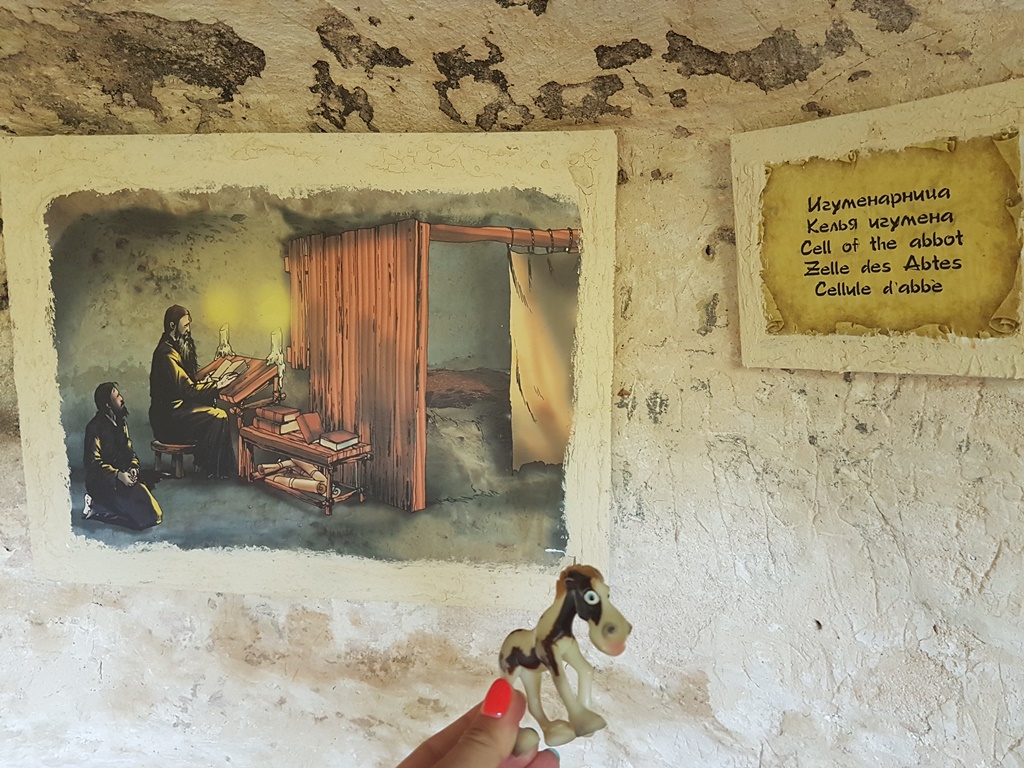
The cell of the abbot was modest.


This is what it is believed to have looked like in the twelfth century.


If the cell of the abbot was modest then I am not sure which word to use to describe the cell of a monk. I think the space is only sufficient to lie down and sleep. No personal belongings, no privacy.


At least the refectory and kitchen were large.


The highest floor includes a smaller corridor. I would expect the monks did nothing but kneel there - it was probably 1.5 meter high.


But the best reward from climbing up the cliff is the view. With the see in front and the mountain behind - it is very feng shui in the end.