Today we will stay in Biskupin but jump over centuries to another settlement, this time belonging to the Lusatian culture. Humans have lived here around three thousand years ago.
The area is covered with peat meadows as it is close to the Biskupin lake.
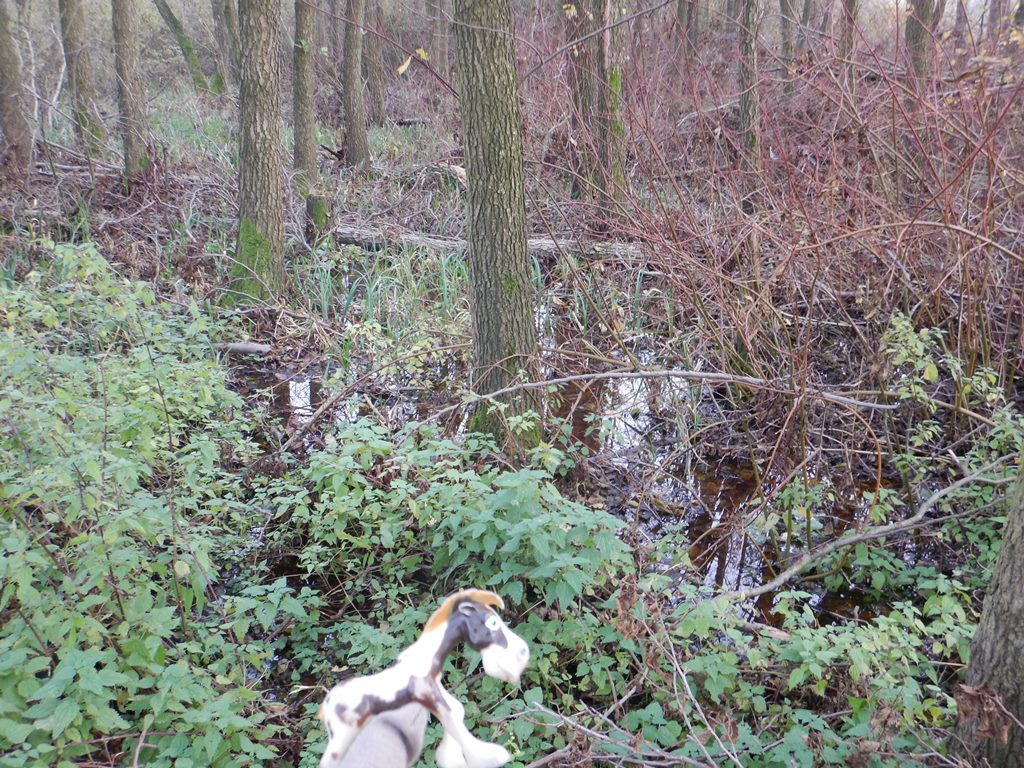
In the old days, there used to be a peninsula on the lake. On this marshy peninsula lied a fortified settlement, with an area of about 2 hectares.
The remainings of the settlement were discovered a hundred years ago by a school teacher who took his class on a trip here. His attention was caught by these piles standing in the marches.
These are authentic parts of the Lusatian settlement, most of which is nowadays 2-3 meters below ground level. Archaeologists have uncovered it some time ago but since wood is not coping well with fresh air, they have buried it back. Instead, they have built a detailed reconstruction.
The village was protected by a high wall, with one main gate.
From the top floor, defenders could throw rocks on the potential attackers.
Inside the village, the houses were built in rows, with narrow streets between them.
The wooden construction was reinforced with additional piles at the bottom, serving as foundations. The roof was covered with straw.
Unlike the long houses that we have seen last week, these building include several houses, each occupied by a single family. You can see it by the number of doors - each led to a separate room, being the individual house of a single family. All in all, around one hundred families lived in the village.
Inside the houses, the floor was covered with wood. You will quickly spot the loom and the fire place. Usually, in one of the corners lived the animals. They brought food and also served as living radiators.
The village was surrounded by a wall that was made, I am sure that you are not surprised, of wood.
It was a pretty solid construction, that allowed the defenders to walk on the upper part of the wall and watch out for enemies.
I hope that this trip in time was interesting to you. Let's take another pause to imagine what life looked like in this Lusatian settlement three thousand years ago, when the houses were full of families guarded by the watchtower on the horizon.
Saturday, 9 December 2017
Saturday, 2 December 2017
Archaeological museum in Biskupin (Part 1 - Neolithic long houses)
I will take you today to a unique place that every Polish child learns about at school. Biskupin is a small village where human settlements existed for the last twelve thousand (!) years. It is the most important archaeological site in the country. It is so amazing, that it deserves more than one post. You will not regret it, I promise. So ladies and gentleman - welcome to the Archaeological Museum in Biskupin.
Biskupin lies in the Wielkopolska region. Humans were living here for several thousand years. Therefore, it is possible to visit here villages from different periods.
We will start with a visit to the neolithic village where people lived some six thousand years ago.
They have lived in Biskupin in so-called long houses.
These are called long houses because, not surprisingly, they were up to thirty meters long.
They had the shape of a large trapezium, with the longer edge on the South part, where the main entrance was. This allowed to bring sunlight and warmth into the house.
Inside, the house was really large.
The little holes in the walls allowed to lit the place up. In winter time they were filled with straw to insulate from wind and cold.
On the other hand, the large holes in the floor were used as fridges. They would be covered with earth and experiments show that the temperature in such a neolithic fridge would be close to that in modern fridges we have in our houses.
What is interesting, archaeologists have found in the long houses pieces of ceramics but not fireplaces.
Neolithic humans were sleeping on beds made of branches and grass. Surprisingly comfortable.
And pretty warm if you would cover yourselves with animal furs.
You could also try to weave some linen clothes on those prehistoric looms.
Neolithic humans were hunters and farmers. When they were out of their long houses, they would stay in huts.
They could keep there also their fishing equipment.
What I found interesting is that they were fishing in boats made out of a single trunk of a tree, in which they would pick a whole to sit in.
If you are curious why the neolithic people have chosen Biskupin for their settlement, the main reason is actually water. Or more precisely this spring, which used to be the source of drinking water for inhabitants of Biskupin over severeal millenia. Many of them believed it to be a sacred place as well. So why don't we stop here today to meditate and feel the connection with the nature and our ancestors.
Etykiety:
archaeology,
Biskupin,
ship
Kites' festival
I must tell you honestly that I am not a huge fan of autumn. When it gets dark and windy, my motivation to travel falls significantly and all I dream of is a warm blanket and a bucket of hot water.
But some humans manage to turn the biggest disadvantes of autumn into an opportunity for good fun. Windy autumn is the best time for a kite festival! If you want to play with kites, especially in a bigger group, you need space. A large field will be best.
First, the kites will pass by a jury who will assess the construction and the decorations. The two most popular shapes are a hexagon and a diamond.
Some participants prepared decorations which are cute and funny, like those smiling vegetables.
Others decided to scare their opponents. Pirates of the air, ahoy!
Personally, I liked a lot this rose in a pot.
Finally, the jury calls the participants to move on their marks. The kites will fly on long string. They also have a tail, usually decorated with bows and fans.
All participants are aligned in a row, ready to launch the kites.
And here they go!
I think that I know who might win this race, just look at this one, flying soooo high.
In the end, windy autumn does offer some reasons to go outside.
But some humans manage to turn the biggest disadvantes of autumn into an opportunity for good fun. Windy autumn is the best time for a kite festival! If you want to play with kites, especially in a bigger group, you need space. A large field will be best.
First, the kites will pass by a jury who will assess the construction and the decorations. The two most popular shapes are a hexagon and a diamond.
Some participants prepared decorations which are cute and funny, like those smiling vegetables.
Others decided to scare their opponents. Pirates of the air, ahoy!
Personally, I liked a lot this rose in a pot.
Finally, the jury calls the participants to move on their marks. The kites will fly on long string. They also have a tail, usually decorated with bows and fans.
All participants are aligned in a row, ready to launch the kites.
And here they go!
I think that I know who might win this race, just look at this one, flying soooo high.
In the end, windy autumn does offer some reasons to go outside.
Saturday, 25 November 2017
Jasna Góra
It is hard to believe but almost six years have passed since we have visited Częstochowa with my friends from Postcrossing.com. When we were there, we did not visit the shrine of Jasna Góra, the most important place for all Catholics in Poland. We will visit it today.
The road to the shrine is bordered by national flags of all the pilgrims. Every year, three million pilgrims visit Częstochowa.
The main entrance is decorated with the coat of arms of the Polish Pope John Paul II. Totus tuus means "All yours".
The shrine of Jasna Góra is surrounded by tall walls. They used to protect the monks and the treasures of the shrine from military attacks. In 1655 Jasna Góra was under siege, when Swedish army has invaded Poland. The fact that the shrine did not surrender was the pivotal point of the war. Today, the moat outside the wall includes the stations of the Road of Cross. As you walk around, you can withes Jesus Christ falling ...
... and dying.
The beating heart of the shrine is the basilica. Here is the main entrance. On top you can see two sundials. Unfortunately, they do not work on a rainy day.
The first basilica was built in the sixteenth century. It was rebuilt a number of times, last time in baroque style.
But the most important place in the basilica is the side chapel. It is always full of people.
They all came with one thought in their minds - to place all their hope in the queen of Jasna Góra.
The miraculous painting of Our Lady of Jasna Góra is a national treasure. One of the Polish Kings has officially declared her the Queen of Poland. Her dark face gave her the nickname "the Black Madonna".
And if you do not believe in miracles, just look on the walls. All those crutches were left here by people who do not need them anymore.
The walls of Jasna Góra are filled with items that the pilgrims leave to Our Lady so that she gives them what they need the most. You can find there gold, silver and jewellery.
But also modest wooden rosaries. Because Virgin Mary cherishes rosary beyond all human treasures.
The road to the shrine is bordered by national flags of all the pilgrims. Every year, three million pilgrims visit Częstochowa.
The main entrance is decorated with the coat of arms of the Polish Pope John Paul II. Totus tuus means "All yours".
The shrine of Jasna Góra is surrounded by tall walls. They used to protect the monks and the treasures of the shrine from military attacks. In 1655 Jasna Góra was under siege, when Swedish army has invaded Poland. The fact that the shrine did not surrender was the pivotal point of the war. Today, the moat outside the wall includes the stations of the Road of Cross. As you walk around, you can withes Jesus Christ falling ...
... and dying.
The beating heart of the shrine is the basilica. Here is the main entrance. On top you can see two sundials. Unfortunately, they do not work on a rainy day.
The first basilica was built in the sixteenth century. It was rebuilt a number of times, last time in baroque style.
But the most important place in the basilica is the side chapel. It is always full of people.
They all came with one thought in their minds - to place all their hope in the queen of Jasna Góra.
The miraculous painting of Our Lady of Jasna Góra is a national treasure. One of the Polish Kings has officially declared her the Queen of Poland. Her dark face gave her the nickname "the Black Madonna".
And if you do not believe in miracles, just look on the walls. All those crutches were left here by people who do not need them anymore.
The walls of Jasna Góra are filled with items that the pilgrims leave to Our Lady so that she gives them what they need the most. You can find there gold, silver and jewellery.
But also modest wooden rosaries. Because Virgin Mary cherishes rosary beyond all human treasures.
Subscribe to:
Posts (Atom)


