Saturday, 4 July 2015

Nałęczów

Nałęczów is a nice little town, just 150 kilometers from Warsaw. It is famous for its health spa specialising in cardiologic treatments.

Nałęczów is populated with picturesque villas, which accommodate nowadays small hotels and health institutes. Many of them are over 120 years old. For some it is clearly visible at first site, like in case of villa Mazowsze.


For others it is not easy to guess, like for villa Aurelia ...


... or villa Tolin.


Many villas are surrounded by nice gardens.


Others offer their guests the possibility to take a cup of frozen tea outside.


Those that cannot offer a large green garden try to put green elsewhere, even on the walls.


In fact also public buildings are often located in nice villas. Like this school of artistic handcraft.


 And this one is a post office.


Unfrotunately no villa was large enough to accommodate the town hall. This is why it is located in this ugly building.


Alright, it is time to move to the biggest attraction in town - the health spa park. It is much bigger than the one I have shown you in Busko-Zdrój. This is the main entrance.


 In spring and summer, the park is ornamented with flower carpets.


The name of the town comes from the coat of arm of its former owners, the Małachowski family. Their palace is still standing in the park.


Today it houses the museum of one of the most famous Polish writers - Bolesław Prus.


Horses are not allowed inside the museum. I think it is outrageous. I told it to Prus himself, when we were chatting in the park.


One of the nicest features of the park in Nałęczów is a little lake.


 It even has a small islet that can be accessed by a romantic bridge.


The health spa in Nałęczów was founded in 1878. Its main building is located in the park, facing the lake. The view must be really relaxing.


The building of the Pump Room, when health waters can be tasted, is modern - it was built in 1964.


I remember that the water in Busko had a horrible smell and taste. This one at least does not smell sulfur.


Unfortunately the taste is not inviting, the mineral water is full of iron ions.


I propose that we give up on the health water. Beware! The guard seems to get angry - everybody should appreciate the local water I guess. Let's hide behind the palm trees. The oldest of them is over a hundred years old.


Alright, we managed to run away. I propose that we spend the rest of the afternoon sitting by the lake, feeding the swans.


Saturday, 27 June 2015

Wolfschanze

Today we will have a little history lesson. I do not know if all of you know that what is now the north-eastern part of Poland, before the Second World War was southern part of Prussia, part of the Third Reich. When Adolf Hitler started in 1941 Operation Barbarossa, he decided that he needed military headquarters, as close to the front as possible. Such a top secret and highly secured place was created near Kętrzyn and is known as Wolf's Lair (in German Wolfschanze).


"Wolf" was a nickname of Hitler, since his name means a noble wolf. But the name Wolfschanze and the real use of the complex was known only to a small group of people, the others thought they worked in the Askania chemical company. It was guarded with the use of military vehicles like these ones.


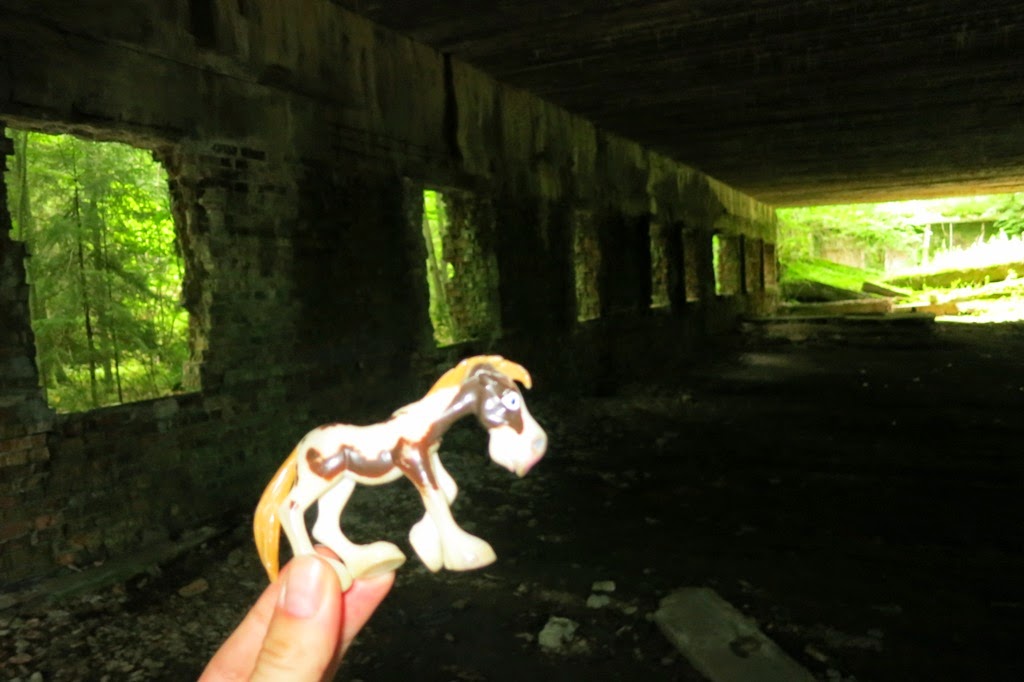
The most important personnel have worked and lived in bunkers built from multi layered ferro-concrete, so thick that bunkers were almost as high as surrounding trees.


Here you can see the height of the bunker in comparison with doors. To improve the security, inside there was only one storey and no windows. To hide the complex at night, only blue light was used. Now we know that such separated light has bad influence on people's sight and mind. It is believed to have had a negative influence on Hitler's mental disease.


But there were also lighter buildings for daily work.


In one of such a buildings, on 20th July 1944, Claus von Stauffenberg performed the best known Fuhrer's assassination attempt. You can watch the story in the movie Valkyrie.


Hitler (number 1 on the chart below) narrowly survived because someone unknowingly pushed the briefcase containing the bomb behind a leg of the heavy conference table. When the bomb exploded, the table deflected much of the blast away from Hitler.


When Soviet armies were approaching, Germans tried to destroy most of the bunkers, so that they cannot be used by ennemy. Even 8 tones of TNT was needed to make the bunker unusable.


Thanks to the dynamite we can now admire the inner construction details and ...


... the power of the nature, both of the flora ....


... and the fauna.


Nowadays the area can be visited and I advise you to take a tour guide. Although the place is made safe, keep in mind how many lives it cost we can live here and visit the incredible places like this.


Saturday, 20 June 2015

Zamość

I am very proud to take you today to yet another UNESCO World Heritage Site in Poland - the pearl of the Renaissance, the ideal city, in short - welcome to Zamość!


Zamość was founded in the sixteenth century and was the capital of the majorat (or fee tail) of one of the most powerful noble families - Zamojski. It was designed to be a perfect or ideal city - functional, safe, citizen-friendly and beautiful. The safety features can be best seen by the city walls.


To enter the city, visitors must have entered through one of many, well-guarded, gates. Some of them were smaller ...


... while others could easily let through big waggons pulled by horses.


As an additional protection, the city walls were surrounded by an external ring of moats. Today the moats no longer carry water - they have been turned up into parks and recreational areas.


The beating heart of Zamość is centered around it Great Market Square. It is truely square - a hundred meters long and a hundred meters wide. On the Northern side of the Great Market Square you will find the Town Hall. From its tower every day a trumpet call is being played. It is played to three cardinal directions - all except West one. The Zamojski family did not want the call to flow into the direction of Kraków, the capital city of Poland at that time. This was their way of showing they disapproved the royal political choices.


Each side of the square includes 8 residential buildings, except the one with the Town Hall.


To see them better I propose that we go up on the terrace of the Town Hall.


Here come the buildings on the Eastern and Southern side.


And here the most beautiful ones, at least in my view. The Armenian Houses were built in Mannerism-Baroque style and are very colourful. You can also find them on most postcards from Zamość.


When we move out of the Great Market Square the streets become slightly less interesting, though they still impress by their regular lines.


The Zamojski family was living, of course, in a huge palace. Nowadays it is the seat of the local and regional court of justice. In its current shape it does not inspire respect or fear as it probably used to three hundred years ago. The only memory of its past glory is the monument of Jan Zamojski and his faithful horse. The monument is very recent, it was only created in 2005.


An ideal, citizen-friendly city was obviously centered not only around the palace of the local nobility, no matter how powerful it was. Jan Zamojski has founded the Zamojski Academy, so a university, open to all inhabitants, including bourgeoisie. Today, the building houses a secondary school and still serves educational purposes.


Just a few steps from there you will find the seminary (or theological college) of Zamość. In the back you will see again the tower of the Town Hall.


You will not be surprised to hear that next to the seminary stands the Zamość cathedral. It was built towards the end of the sixteenth century, in Renaissance style.


It can be best seen by its ceiling (do you remember the gothic ceilings of the cathedral in Wrocław?).


Next to the ceiling there are 85 rosettes made of stone. Each has a different design.


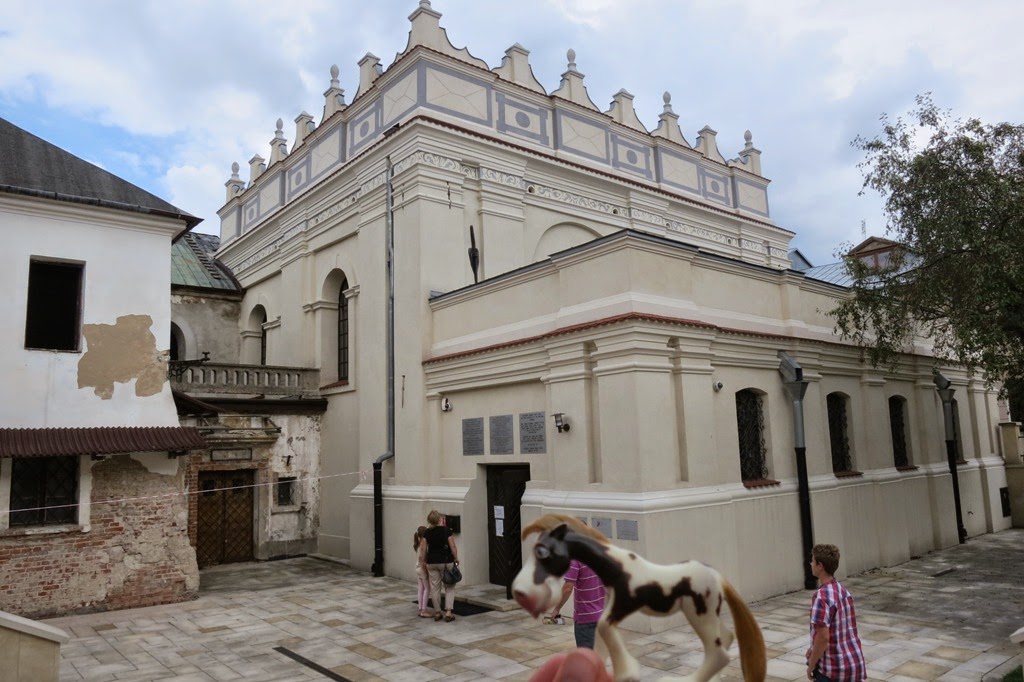
Those of you who have been reading my blog for a longer time sure guessed that in this part of Poland Catholics could not have been the only religion in the past. You are right my friends - the tolerant Zamojski family has allowed Jews to live in their capital starting from 1588. In 1929 they constituted half of the city's population. Their most important place of prayer was the synagogue at Zamenhoffa Street, the best preserved Renaissance synagogue in Poland.


It has been recently refurbished and is being used as an art gallery. It is also an important element of the Chassidic Route.


One could think that a city that was designed in line with some utopic (in the best sense of the word) ideas will not survive the pressure of time. Well, quite the opposite. Zamość is a city still alive, with nice new buildings being added in the outskirts of the Old Town.


As in any case, it is dependent on the people who live there. Zamość was lucky to give to Poland one of it biggest poets and singers of the second half of the twentieth century - Marek Grechuta.


My favourite song by Grechuta is entitled "The days that we do not know yet". It brings a strong message that whatever happens in life the only moments that matter in life are these that are still to come.