Saturday, 19 December 2015

Horgen

Last week we were in Thalwil. Today I will take you to the neighbouring town of Horgen, in order to allow you to see a typical Swiss village a bit closer.

Horgen is the capital of the Horgen district (I am sure that you have noticed that Swiss people are thrifty and limit the amount of geographic terms that they use).

"Karte Kanton Zürich Bezirke 2010" by Tschubby - Own work. Licensed under CC BY-SA 3.0 via Commons

Let's start our trip today next to the regional office. It is far from being impressive.


The town of Horgen has something around twenty thousand inhabitants. As in most Swiss towns, Roman catholics and reformed live next to each other. Even the churches are close enough so that it is possible to catch both towers in the same picture.


The catholic church of Saint Joseph is quite modern in style.


 Let's move down to the old town.


The first human settled in the Horgen area already in prehistoric times. There are documented remainings of the Pile Dwellings around the Alps, a UNESCO World Heritage Site. But if you look at the building here, they seem pretty modern, being probably a hundred or two hundred years old.


This is also the case for the reformed church, which has been built towards the end of the eighteenth century.


Let's move on in the direction of the Zurich Lake. This cubic building is the Town Hall.


To arrive at the lake side, we will take the little bridge, or passerelle as they call it here.


On the left you can see the train station ...


... and on the right the Horgen-Meilen ferry that could take you to the opposite side of the lake. I really find this view great, with the Alps as a background.


Let's go down now, to sea (or rather lake) level.


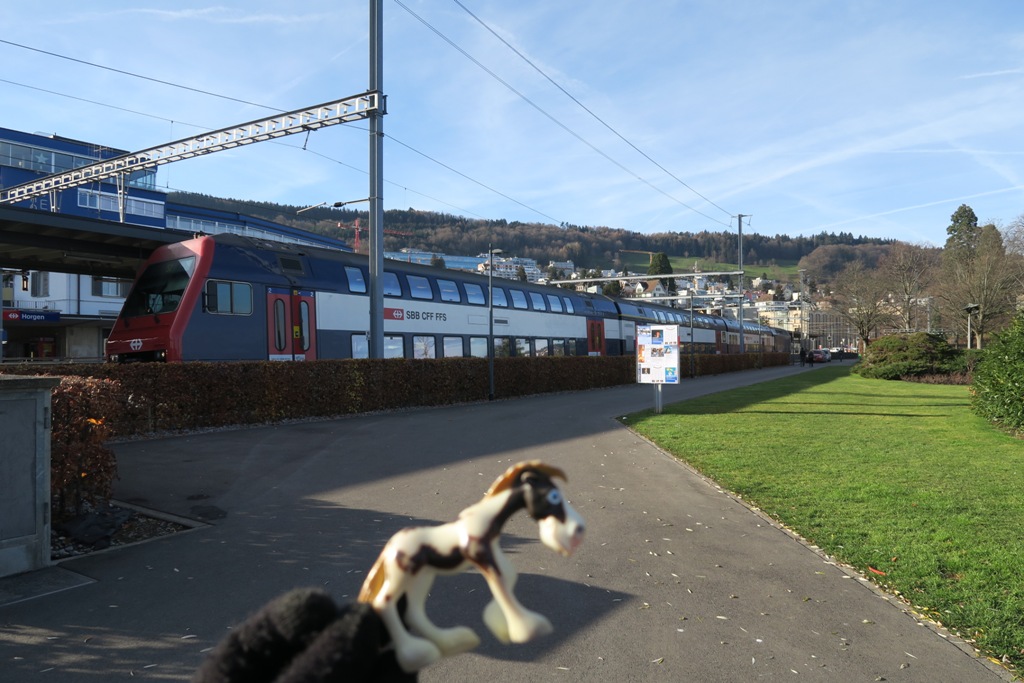
The train has just arrived. You did not hear it coming? No worries, nothing is wrong with your hearing. Swiss trains are like ninjas - they move without making any sound.

On the pier you will find some seagulls waiting patiently.


In the water some ducks and a young swan.


They all hope that we have some bread for them. I did bring a bit and will throw it to them. I suggest you take a step back unless you want to feel like in a Hitchcock movie.


Next to the pier you can spot a little marina, where the boats of the inhabitants of Horgen hibernate during winter months.


Behind them stands one of the nicest buildings in Horgen - the Villa Seerose.


Let's have a closer look. To the left my friends.


Villa Seerose used to belong to a rich industrial family. Nowadays it houses the music school of Horgen.


In front, there is a little park with some sculptures I would have difficulties to describe.


The Villa has given its name to the lake swimming pool.


We have visited it already in summer time, so now only a glimpse to see what it looks like without all these people (and without leaves on the trees).


If we go down the Seegartenstrasse (or the Lake-garden-street) we will see another nice villa, built for another rich industrial family - the Herner Villa.


It is not open to public but could be rented out for some zillions of Swiss francs. Just on the other side of the street comes the Herner garden, which probably used to be part of the same property before the street was created. Now it looks a bit like the Secret Garden.


Let's try to look inside.


This nice little path leads directly to the lake shore.


If we could enter inside, I could show you the lake pavilion. But since it is a private residence, I can only show you some pictures found on the internet.

Badepavillion

I hope that you have enjoyed this insight into a typical Swiss town in the canton of Zurich. This was quite a long walk so I propose that we sit for a while on this nice bench before we set off for some new adventures.


Those of you who speak a bit of German have probably already noticed that it was founded by the Horgen Tourist Office. What a nice idea. The practical nature of Swiss people has definitely many upsides.


Saturday, 12 December 2015

Fair in Thalwil

One of the amazing things about Switzerland is that it is largely made of small towns and villages where the spirit of local community is very strong. Today I will take you to Thalwil, a nice little township next to the Zurich Lake, to show you a typical local fair. The main street is packed with stands.


Like in most towns around the Zurich Lake, the main street is steep.


The stands are mainly used to sell food. What was amazing is that a large part of them was run by local sportive teams. Swiss people are really keen on sport. You can eat (and support) the handball team ...


... the tennis club ...


... or the swimming club.


If you do not like to swim yourself, you can try rowing.


Or maybe you are a motorbiker?


The shooting club is also here, though this one is based in a village nearby, called Langnau am Albis.


But you can find on the fair also food that is not affiliated to a particular team or activity. This stand offers the local speciality, called here marroni.


Yes, you guessed it right, these are chestnuts, or more precisely sweet chestnuts. Very tasty.


Those who like sweet things will surely not miss this stand.


And those accompanied by children will not be allowed to ignore that one.


Finally, we arrive to the main square towards the end of the street. Today it is occupied by a funfair. You can try a rollercoaster in Swiss colours.


You can try some bouncing cars.


Last but not least, you can turn around in this carousel. A bit down ...


... and a bit up.


 I know, it is hard to feel the movement just by watching photos. This is why I tried to bring this unique sensation closer to you.


Alive? Or a little seasick? Just sit down, relax, and enjoy the magnificent view from uptown Thalwil.


Saturday, 5 December 2015

Liechtenstein

Today I am really excited. Not only will I take you to a new country. I will take you to a country that is not that easy to be visited because it is one of the smallest in the world - Liechtenstein.


Next to the Tourist Information you will find the "0" point, from which all distances are calculated. Not that they are long of course, after all Liechtenstein has only 160 km² of surface.


The capital city of Liechtenstein is Vaduz. It is the seat of the most important institutions in the principality. This yellow building is one of them.


You may think that it is rather small for a parliament, but remember that the parliament in Liechtenstein includes only 25 people.


Next to it, comes a different type of power place - the National Bank. 13% of the country's GDP is created by the financial industry so one should not underestimate its importance.


Just next to it you will see the seat of the government. This one is also modest since it includes only the prime minister and 4 ministers.


On top over the main entrance you will see the coat of arms of the principality.


Just a few steps further another important place of power - the cathedral. Roman Catholicism is the official state religion of Liechtenstein.


Next to the entrance you can see the previous rulers of the country, Prince Franz Josef II and Princess Gina. Now the country is officially ruled by his son, Hans-Adam II but in reality the current Prince has retired and passed most of his power to his son, Alois.


The cathedral is of course not too big but it is surprisingly full of light.


In the back you can see, of course, the organ. Since we visit the cathedral on a Saturday morning, we can assist a last rehearsal for a wedding ceremony. This is promising to be an unforgettable day.


Alright, let's move out on our tiptoes. And admire the cathedral again. If you look a bit upwards you will for sure notice a building on the top of the hill. This is actually the most important place in the city and the entire country - the palace of the Prince.

We will try to get closer to it. Let's take the main road first. You will see there a number of museums - the historical museum ...


... the art museum ...


... and even the post museum.


But what I really liked was that the main street of Vaduz is by itself a piece of art and an open-air museum.


These nice gentleman live next to the parliament. They are a symbol of the bitter truth that politics are a difficult balancing act.


Look, there is also a horse! Look like my uncle Rusty who used to serve in the army.


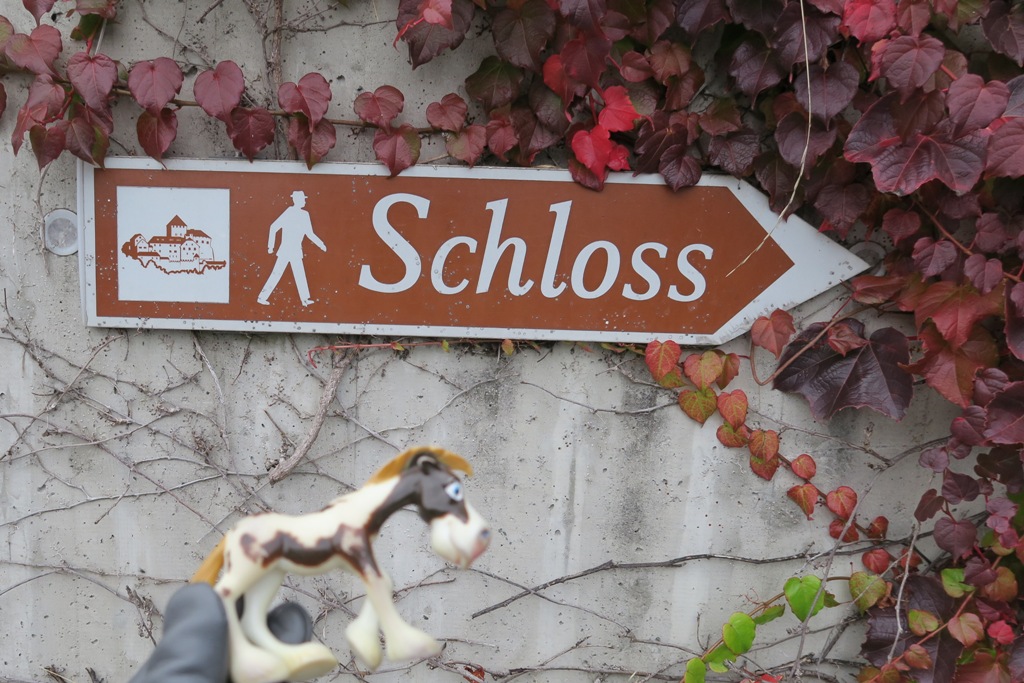
Here it is at last - the pathway to the castle.


Don't worry, it is an easy one, even for those who are not fans of hiking.


On the way you can admire some small waterfalls ...


... and discover important facts about Liechtenstein and its history.


I propose we stop for a second to admire the panorama of Vaduz. Unfortunately, it is already foggy autumn. If we were here on a sunny summer day you could see the Alps all around. Now you will have to believe me that they are here.


Finally, we reach the last turnaround. Here comes the Vaduz castle.


The castle is much older than the state of Liechtenstein, which you can easily guess by its medieval style.


Unfortunately, the castle is not open for the public since the princely family still lives there. You can only try to stretch your neck and look inside the garden.


What is quite amazing is that just on the other side of the street you can see the house of a local farmer.


Now the last point of our visit. Apologies if not all of you were on my address list this time but it really took me over half an hour to write all these down.


And here they go!


I hope that you have enjoyed this trip. I must admit that Liechtenstein has stolen my heart.


I hope that I will be able to come here once again on a sunny day. Just to see this ...

http://nathanwinder.smugmug.com